Section 1: Decoding Custom Knitwear MOQ—Why Minimums Are Calculated “Per Color” Rather Than “Per Style”
For apparel brands and procurement managers launching new knitwear collections, one of the most common points of confusion during early supplier inquiries revolves around Minimum Order Quantity (MOQ) metrics. While buyers usually ask for an overarching “MOQ per style,” factory production realities are fundamentally governed by knitwear MOQ per color.
A factory policy specifying 30 pieces per color and a policy quoting 50 to 100 pieces per style are often two perspectives of the same operational framework. Understanding the underlying math avoids unexpected cost overruns during production scaling.
Q: Why Can’t Knitwear Minimums Be Calculated Uniformly “Per Style”?
Unlike woven garment manufacturing, which starts with bulk fabric rolls that manufacturers lay flat and cut into individual panels, knitwear manufacturers feed raw yarn cones directly into computerized flat knitting machines, such as Stoll or Shima Seiki.
The constraint lies in the yarn dyeing process and machine setup parameters:
- Vat Dyeing Minimums: Industrial yarn dye vats require a minimum liquid and yarn volume to achieve uniform color saturation and chemical levelness. Dyeing a small quantity below the vat capacity causes color streaking, shading variations, and excessive chemical waste.
- Knitting Machine Calibration: Setting up tension, stitch density, and yarn feeders for a specific yarn color requires dedicated labor. Running fewer than 30 pieces per color setup significantly increases per-unit setup overhead.
Q: What Is the Actual Total Minimum for a 5-Color Knitwear Collection?
If an apparel brand plans a single sweater style across 5 distinct colorways, calculating order volumes based purely on a low “per style” expectation leads to mathematical discrepancies.
| Order Requirement | Color | Minimum Quantity per Color | Total Quantity |
|---|---|---|---|
| Factory Minimum Requirement | Color A | 30 pcs | 30 pcs |
| Factory Minimum Requirement | Color B | 30 pcs | 30 pcs |
| Factory Minimum Requirement | Color C | 30 pcs | 30 pcs |
| Factory Minimum Requirement | Color D | 30 pcs | 30 pcs |
| Factory Minimum Requirement | Color E | 30 pcs | 30 pcs |
| Total Order Volume | 5 Colors | 30 pcs/color | 150 pcs |
To produce a 5-color capsule, the brand must commit to 150 total pieces (30 pieces * 5 colors) to satisfy the dye-lot and machine efficiency thresholds for each hue.
Q: Are There Flexible Workarounds for Small-Batch Custom Knitwear Orders?
Brands looking to test the market with small-batch production runs without overextending inventory capital can utilize three industry-standard strategies:
- Stock Service Yarns: Utilize factory stock-supported yarn colors. Because stock yarns are dyed in massive industrial batches, buyers can bypass custom dye-vat minimums and achieve flexible order volumes.
- Unified Base Colors with Variable Trims: Keep the primary body color consistent across the run and introduce variety using contrasting collar trims, cuffs, or embroidered placements.
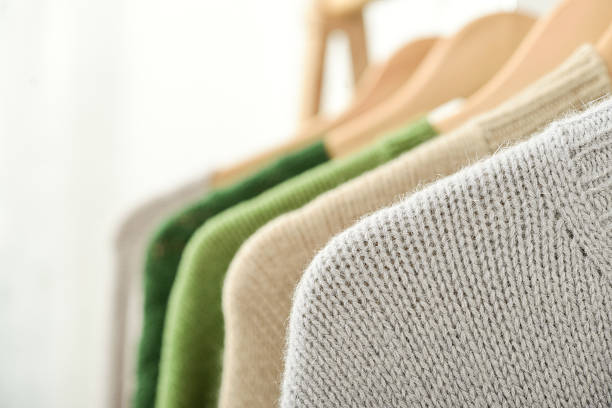
- Consolidated Color Schemes: Reduce the initial collection launch from 5 colors down to 2 or 3 core neutral shades (e.g., Black, Oat, Navy) to optimize order units per colorway.
Section 2: Breaking Down Yarn FOB Costs—From $14 Cotton to $66 Cashmere Blends
When evaluating factory quotes for custom sweaters, decision-makers often see extreme price variances for garments that appear visually similar. According to benchmark FOB cost indices across global knitwear supply chains, FOB unit prices scale dramatically depending on fiber composition, fiber fineness, and finishing treatments:
$13.98 (Cotton) ──► $17.36 (Wool Blend) ──► $44.27 (Merino Wool) ──► $66.05 (Wool/Cashmere Blend)Understanding what drives these price gaps allows procurement teams to balance budget allocations against retail performance targets.
Q: How Much Does the Wearability Experience Differ Between a $14 and a $44 Sweater?
Fiber architecture, thermal regulation, and structural recovery create the price gap between a $13.98 cotton sweater and a $44.27 100% Merino wool sweater.
| Performance Attribute | Cotton Knitwear (≈$13.98 FOB) | Merino Wool Knitwear (≈$44.27 FOB) | Wool/Cashmere Blend (≈$66.05 FOB) |
| Fiber Micron / Diameter | Thick plant fiber (≥ 20 μm) | Ultrafine animal fiber (18.5 μm – 19.5 μm) | Grade-A Cashmere (14 μm – 15.5 μm) |
| Warmth-to-Weight Ratio | Low (Heavy weight required for warmth) | High (Lightweight insulation via natural crimp) | Exceptional (Maximum insulation, ultra-soft hand feel) |
| Moisture Management | Retains moisture; slow to dry | Natural breathability & moisture wicking | Superior breathability & soft skin contact |
| Shape Memory & Wrinkle Resistance | Prone to sagging & stretching over time | High natural elasticity; active bounce-back | Delicate structure requiring stabilization |
Q: When Is It Worth Investing in Merino Wool or Cashmere Blends?
Product positioning dictates material selection:
- Entry-Level & Fast-Fashion Retail ($13.98 – $17.36 FOB): Cotton and wool/acrylic blends excel in spring/summer capsule collections, casual everyday wear, or high-turnover fashion lines where low price points and easy machine-washability take priority.
- Premium & Performance Outerwear ($44.27 FOB): 100% Merino wool is essential for outdoor activewear, professional thermal layers, and premium contemporary brands where breathability, odor resistance, and long-term shape retention drive customer loyalty.
- Luxury & Heritage Collections ($66.05+ FOB): Wool/Cashmere and 100% Cashmere blends are ideal for high-end luxury retail, boutique fall/winter flagship collections, and executive gift lines that command high retail margins based on touch, softness, and prestige.
Q: How to Select the Optimal Yarn Blend Within a Fixed Target Budget?
Procurement teams can optimize production margins using fiber engineering principles:
- Blended Yarn Formulations: Combine high-grade natural fibers with functional synthetics or cotton (e.g., 90% Wool / 10% Cashmere or 50% Merino / 50% Anti-Pilling Acrylic) to capture luxury soft hand-feel while keeping raw material costs within target thresholds.
- Gauge Manipulation: Adjust machine gauge (e.g., 7G heavy knit vs. 12G or 14G fine gauge). Fine gauge sweaters use less total yarn weight per garment, lowering raw material costs while maintaining a sophisticated look.
- Stock Color Selection: Select mill-standard yarn colors rather than paying custom lab-dip and custom dye-lot surcharges.
Technical Knowledge Summary
Successfully managing custom knitwear procurement requires aligning production logistics with material engineering. MOQ per color guarantees that yarn dyeing vats and flat knitting machines maintain color uniformity and operational efficiency, whereas total style volumes scale linearly with the number of colorways chosen.
On the material side, fiber fineness (microns), thermal capacity, and mechanical recovery directly drive FOB price differences, from $13.98 for entry-level cotton to $66.05 for luxury cashmere blends. By selecting appropriate fiber blends, utilizing stock yarns, and matching machine gauges to target price points, brands can build cost-effective, high-performing knitwear lines.
Next Steps for Your Knitwear Collection
Planning a custom knitwear production run or developing a seasonal capsule? Contact our technical design team with your target market positioning, design sketches, and budget parameters to receive a tailored yarn selection guide, lab-dip color consultation, and comprehensive FOB quote reference.