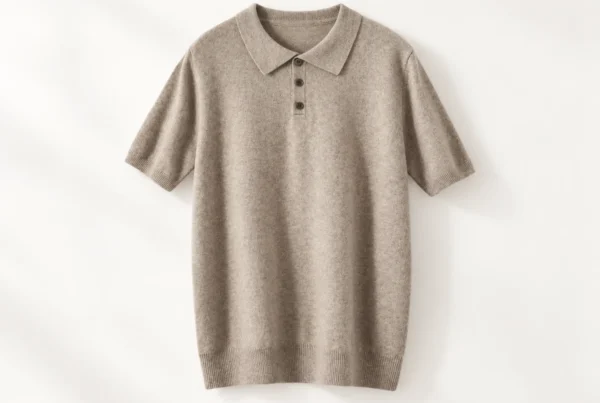
For apparel buyers and sourcing managers, machine gauge often appears as a key sweater quality specification. A typical tech pack may simply request a 7G crewneck sweater or 7-gauge chunky knit sweater.
However, machine gauge alone does not determine sweater thickness, weight, or hand-feel.
Two sweaters produced on identical 7G flat knitting machines can have significantly different fabric structures. One may feel dense and heavy, while another may feel light, loose, and more likely to sag.
The difference comes from the interaction of three core manufacturing variables:
Machine Gauge + Yarn Count/Ply + Stitch Density
Understanding these three parameters helps procurement teams control garment weight, fabric structure, dimensional stability, and bulk production consistency.
What Does 7G Mean in Sweater Manufacturing?
7G refers to the machine gauge used to produce the knitted fabric.
Machine gauge defines the number of needles positioned across one inch of the needle bed. Therefore, it primarily describes needle spacing, rather than finished sweater thickness.
For a 7-gauge flat knitting machine:Needle Pitch=1 inch7 needles≈3.63 mm\text{Needle Pitch}=\frac{1\text{ inch}}{7\text{ needles}}\approx3.63\text{ mm}
A 7G machine is suitable for medium-to-coarse knitted structures. However, the same needle bed can process different yarn configurations and stitch densities.
This means that two products can both meet a 7G sweater manufacturing specification while having very different weights and hand-feel.
The Three Factors That Determine 7G Sweater Weight
1. Machine Gauge Controls Needle Spacing
Machine gauge establishes the mechanical foundation of the knitted structure.
A 7G needle bed provides approximately 3.63 mm between needle centers. The yarn diameter and the amount of yarn fed into each needle determine how fully the needle hook is occupied.
A thin yarn configuration can create a lighter and more open structure.
A thicker or multi-end yarn configuration can produce a denser and heavier sweater.
Therefore, 7G should be treated as a machine specification rather than a complete fabric specification.
2. Yarn Count and Ply Determine Yarn Volume
Yarn count describes yarn fineness, while ply or the number of ends determines the total yarn volume entering the knitting structure.
For example, a worsted wool yarn may use specifications such as 2/28Nm, while different numbers of ends can be fed into the same 7G machine.
Consider two production configurations:
- Single-end configuration: A 2/28Nm yarn produces a thinner and lighter knit.
- Three-end configuration: Three ends of 2/28Nm yarn create a substantially denser and heavier structure.
The machine gauge remains 7G in both cases.
Therefore, yarn count and total ends fed should appear alongside gauge in the technical specification.
3. Stitch Density Controls Loop Packing
Stitch density determines how tightly the knitted loops are packed.
Two important measurements are:
- Wales Per Inch (WPI): Horizontal loop density.
- Courses Per Inch (CPI): Vertical loop density.
Knitting technicians can adjust stitch cam settings to change loop length.
A shorter loop length creates tighter packing and a firmer fabric structure.
A longer loop length produces more open loops, increasing fabric looseness and stretch while reducing dimensional stability.
This makes CPI and WPI important quality-control parameters for custom sweater production.
Why Two 7G Sweaters Can Have Different Weights
The following example demonstrates how yarn configuration and stitch density change the final garment.
| Construction Parameter | Light / Loose | Standard Commercial | Chunky / Heavyweight |
|---|---|---|---|
| Machine Gauge | 7G | 7G | 7G |
| Yarn Specification | 2/28Nm Wool, 1-Ply | 2/28Nm Wool, 2-Ply | 2/28Nm Wool, 4-Ply |
| Average Garment Weight (M) | ≈260–300g | ≈420–460g | ≈580–650g |
| Stitch Density | Low | Medium | High |
| Fabric Structure | Loose, open loops | Balanced commercial structure | Tightly packed |
| Hand-Feel | Soft, semi-sheer | Balanced drape | Heavy and structured |
| Main Risk | Shrinkage and shape distortion | Balanced cost and performance | Higher yarn consumption and unit cost |
The key point is simple:
The three garments are all 7G, but their yarn and density specifications create different performance characteristics.
7G Gauge vs. Yarn Count vs. Stitch Density
For procurement teams, these parameters should not be evaluated separately.
| Parameter | What It Controls | Procurement Impact |
|---|---|---|
| Machine Gauge | Needle spacing | Defines the basic knitting structure |
| Yarn Count | Yarn fineness | Influences fabric weight and texture |
| Yarn Ply / Ends | Total yarn volume | Changes thickness and garment weight |
| WPI | Horizontal loop density | Affects fabric compactness |
| CPI | Vertical loop density | Affects length and dimensional behavior |
| Target Garment Weight | Finished product mass | Provides a direct bulk-production benchmark |
This integrated approach gives buyers a more reliable specification than simply requesting 7G.
How to Specify a 7G Sweater in a Tech Pack
A strong sweater specification should define the construction parameters together.
Step 1: Specify Machine Gauge and Needle Type
Instead of listing only “7G,” specify the machine configuration where possible.
For example:
7G computerized flat knitting machine with standard hook
This creates a clearer baseline for sample development and production communication.
Step 2: Specify Yarn Count and Total Ends
Define both yarn count and the number of ends fed into the machine.
For example:
2/28Nm worsted wool or wool-blend yarn, 3 ends fed in parallel
This prevents manufacturers from interpreting “7G” with different yarn configurations.
Step 3: Set a Target Garment Weight
Garment weight provides a practical production control point.
For example:
Size L target weight: 480g ±15g
The target should be linked to the approved sample and specified garment size.
This helps sourcing teams identify material or density changes during bulk production.
How to Check WPI and CPI During Sampling
After receiving a counter-sample, procurement teams can check stitch density before approving bulk production.
WPI Inspection
Count the number of visible wales across the horizontal direction of the knitted panel.
CPI Inspection
Count the number of courses along the vertical direction.
Record both values in the pre-production approval file.
If bulk production deviates significantly from the approved WPI/CPI targets, changes in loop length may affect garment weight, dimensions, and hand-feel.
The source specification uses ±5% as the control reference for approved WPI/CPI targets.
Why Post-Wash Testing Matters for 7G Knitwear
A loose 7G knit may appear acceptable before washing but change significantly after laundering.
Higher loop length and lower stitch density can increase the risk of:
- Shape distortion
- Washing shrinkage
- Stretching
- Sagging
- Dimensional instability
For this reason, prototype samples should undergo standard laundering or dry-cleaning tests before bulk approval.
The objective is to verify whether the selected yarn, gauge, and stitch density maintain the required garment dimensions after care processing.
Common 7G Sweater Manufacturing Questions
Is 7G the same as sweater thickness?
No.
7G defines needle spacing, not finished sweater thickness.
Thickness and weight depend on yarn count, yarn ply, stitch density, and the resulting loop structure.
Can two factories produce different sweaters using the same 7G machine?
Yes.
Different yarn counts, yarn ends, loop lengths, and stitch-density settings can produce substantially different garments on the same gauge machine.
Is 7G suitable for chunky knit sweaters?
Yes, but the gauge alone does not define a chunky structure.
A chunky 7G sweater also requires an appropriate yarn configuration and stitch density to achieve the intended weight, thickness, and hand-feel.
What should buyers specify instead of only “7G”?
A more complete specification should include:
Machine Gauge + Yarn Count + Total Ends + WPI/CPI + Target Garment Weight + Post-Wash Dimensional Requirements
This provides manufacturers with measurable production targets.
A Better Procurement Standard for 7G Sweaters
The main sourcing risk comes from treating machine gauge as the complete definition of knit quality.
A reliable technical specification should connect:
7G Machine → Yarn Count/Ply → Stitch Density → Garment Weight → Post-Wash Stability
This sequence gives buyers measurable checkpoints from sampling through bulk production.
For custom knitwear projects, procurement teams should document these parameters in the tech pack and compare bulk samples against the approved construction specifications.