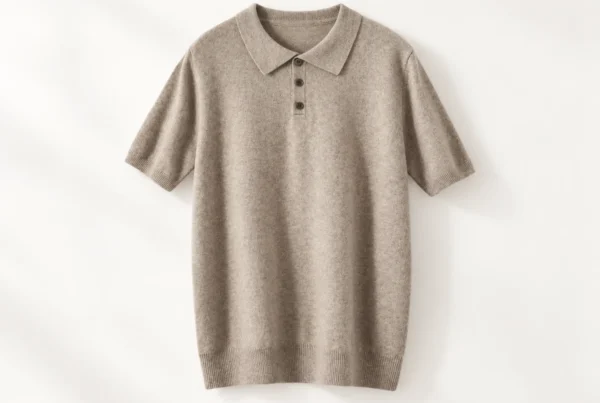

For apparel brands, fashion retailers, and garment sourcing teams, few production issues are more frustrating than receiving bulk knitwear that feels rougher, stiffer, or heavier than the approved sample.
Both garments may carry the same label, such as “100% Cotton” or “100% Merino Wool,” yet their softness, drape, and surface texture can differ noticeably. These inconsistencies may affect customer satisfaction, product reviews, and brand reputation.
The problem often starts before knitting or finishing. Generic fiber labels do not fully define the raw material properties that determine fabric handfeel. Differences in fiber fineness, staple length, yarn count, yarn twist, and fiber blending can all contribute to variations between sampling and bulk production.
For buyers sourcing custom knitwear, a more reliable approach is to establish a dual verification framework for yarn selection: evaluate both fiber characteristics and yarn construction, then use appropriate test reports and production controls to verify consistency.
1. Why Does Bulk Knitwear Feel Different from the Approved Sample?
The handfeel of a knitted garment depends on several interacting variables. Matching the fiber composition label alone does not ensure that two yarn batches will produce identical fabric.
Three factors deserve particular attention during supplier evaluation.
Fiber Fineness and Staple Length
Fiber fineness affects how individual fibers interact with the skin. Finer wool fibers generally create a softer, less prickly sensation, while coarse fibers may feel more noticeable against sensitive skin.
Staple length also influences yarn formation. Longer cotton fibers can support smoother, stronger yarns under suitable spinning conditions. Shorter fibers may contribute to a fuzzier surface and can affect yarn strength and pilling behavior.
Yarn Count, Twist, and Ply
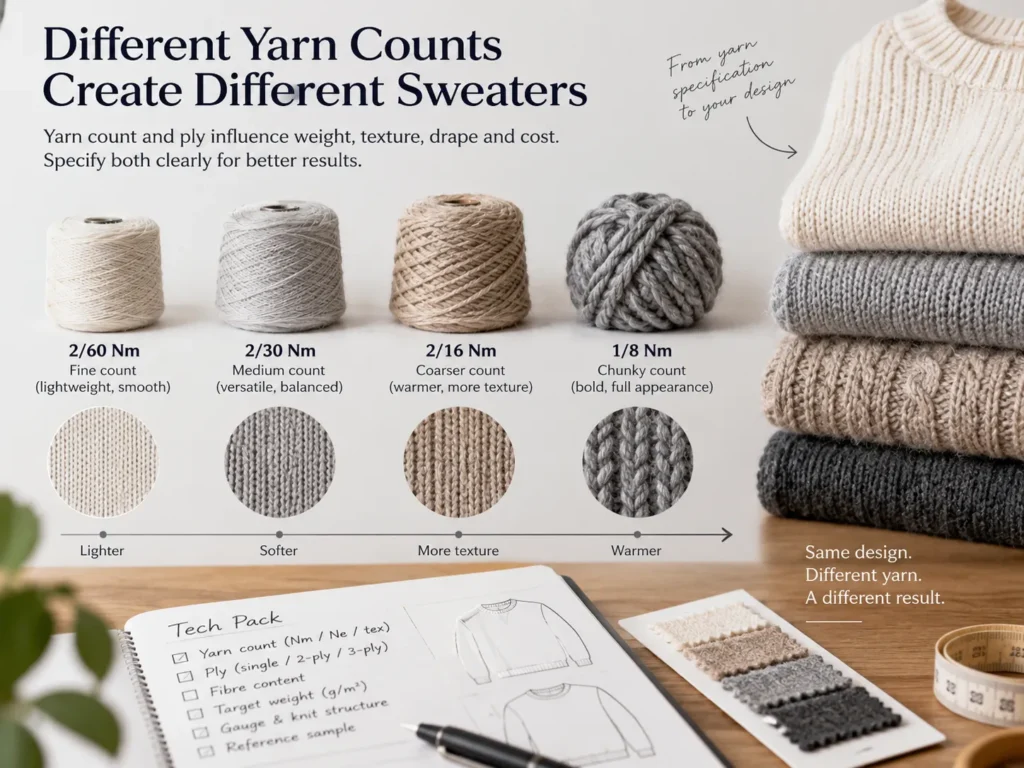
Yarn count describes yarn fineness or coarseness. Within the same yarn-count system, a higher count generally represents a finer yarn. However, the relationship between yarn count and finished fabric handfeel depends on the count system, ply construction, knitting gauge, and fabric structure.
For example, 30s/2 and 60s/2 describe different yarn constructions, but their actual properties should be compared using the specified count system and ply details. Yarn twist also matters: excessive or insufficient twist can affect softness, strength, surface hairiness, and fabric behavior.
Dyeing, Finishing, and Knitting Conditions
Raw material is only part of the equation. Dyeing chemistry, softener application, washing, heat setting, knitting tension, and fabric relaxation can change the final texture and drape.
Therefore, when bulk knitwear differs from an approved sample, buyers should investigate the complete production process rather than assume that the yarn alone is responsible.
2. The Dual Verification Framework for Yarn Selection
A reliable yarn specification should define both the properties of the fibers and the construction of the finished yarn.
| Verification Metric | What to Check | Why It Matters |
|---|---|---|
| Fiber fineness | Fiber diameter for wool; suitable fineness indicators for cotton | Helps establish expected softness and tactile comfort |
| Staple length | Fiber length range and consistency | Influences yarn strength, smoothness, and hairiness |
| Yarn count | Ne, Nm, or another agreed count system | Defines yarn fineness and supports construction consistency |
| Twist and ply | Twist level, twist direction, and number of plies | Affects yarn strength, surface texture, and fabric performance |
| Fiber composition | Declared fiber types and blend percentages | Helps verify material identity and prevent unauthorized blending |
| Fiber diameter distribution | Mean, standard deviation, coefficient of variation, and distribution profile where applicable | Helps identify variation within wool fiber lots |
These parameters work together. A yarn may meet the stated fiber composition and count while still producing a different handfeel because its fiber characteristics, twist, or finishing conditions have changed.
2.1 Fiber Fineness: Establishing the Softness Baseline
Fiber fineness refers to the thickness of individual fibers. For wool, fineness is commonly expressed as average fiber diameter in microns.
For example, Merino wool below 19.5 microns is often described commercially as extra-fine, although exact grading terminology can vary by standard and supplier specification. Finer wool generally improves next-to-skin comfort, but the final result also depends on fiber distribution, yarn construction, and fabric design.
Cotton requires a different approach. Cotton fineness and maturity are commonly assessed using appropriate laboratory indicators, including micronaire. Micronaire is not a direct micron-diameter measurement, so it should not be treated as interchangeable with wool fiber diameter.
For procurement teams, a practical specification should define:
- Fiber type and grade
- Staple length requirements where applicable
- Fiber fineness or suitable material-specific measurement
- Acceptable batch variation
- Required laboratory documentation
Buyer takeaway: Avoid relying on broad descriptions such as “premium cotton” or “soft Merino.” Translate these claims into measurable, material-appropriate specifications.
2.2 Yarn Count: Controlling Fabric Weight, Structure, and Drape
Yarn count influences how a yarn performs in a knitted structure. A finer yarn can support lightweight, smooth, or detailed constructions, but yarn count alone does not determine whether the finished garment will feel soft.
A fine-count yarn made from less suitable fibers may still produce an undesirable texture. Likewise, a thicker yarn can feel soft when its fiber properties, twist, and knitted structure are appropriately selected.
When comparing yarn samples, buyers should confirm:
- The yarn-count system, such as Ne or Nm
- Single-yarn count and ply construction
- Twist level and direction, where specified
- Knitting gauge and target fabric weight
- Finished fabric thickness, stretch, and drape
This information helps suppliers reproduce the intended construction rather than simply match a broad yarn description.
2.3 Fiber Diameter Distribution: Looking Beyond the Average
For wool yarns, an average fiber diameter does not tell the whole story. Two batches can share a similar average while having different distributions of fine and coarse fibers.
A fiber diameter distribution report can provide additional insight through a histogram, standard deviation (SD), and coefficient of variation (CV%). These indicators help buyers evaluate variation within the tested fiber sample.
A broader distribution may indicate greater variability in fiber fineness, but it does not automatically prove that a supplier has mixed lower-grade material into the yarn. Results should be interpreted alongside sampling methods, material grade, test uncertainty, and the agreed specification.
For wool procurement, buyers can request an appropriate fiber diameter distribution report, such as one generated using a suitable optical fiber measurement system.
For cotton or blended yarns, select testing methods appropriate to the material rather than assuming that a wool-specific diameter report is sufficient.
3. How Can Buyers Verify Yarn Composition and Prevent Material Substitution?
When a bulk order feels different from the approved sample, buyers may need to confirm whether the yarn composition matches the purchase specification.
Two types of laboratory documentation can support this process.
Fiber Diameter Distribution Reports
For wool, request a report that identifies the tested lot and includes the average diameter and relevant distribution statistics. A full distribution profile can reveal variation that an average value alone may conceal.
Use the results to compare the supplied material with the approved specification. Do not use a single SD or CV% threshold across every wool grade without confirming the applicable testing method and acceptance criteria.
Quantitative Fiber Composition Testing
Fiber composition testing helps determine whether the tested material matches the declared fiber blend.
Methods under ISO 1833 and AATCC 20A may be relevant, depending on the fiber types and applicable test procedure. Buyers should confirm that the chosen method can identify and quantify the specific fibers in the yarn.
These tests can help investigate undeclared synthetic fibers or other composition discrepancies. However, composition testing does not independently establish fiber grade, softness, or staple length.
Best practice: Use complementary tests. Fiber composition analysis verifies material identity, while material-specific fineness and construction checks help assess whether the yarn meets the required quality profile.
4. Which Yarn Blends Offer a Balance Between Cost, Softness, and Durability?
Blended yarns can help apparel brands balance material cost, handfeel, strength, and care requirements. However, there is no universally optimal blend ratio. The right formulation depends on the garment category, target price, performance requirements, and intended customer experience.
The following combinations are starting points for product development, not universal technical recommendations.
| Yarn Blend Example | Potential Objective | Factors to Evaluate |
|---|---|---|
| Cotton and modal or viscose | Improve softness and drape | Blend percentage, wet strength, shrinkage, and care requirements |
| Wool and polyamide | Improve abrasion resistance and yarn durability | Wool grade, polyamide percentage, pilling, and target handfeel |
| Cotton and recycled polyester | Balance cost, dimensional stability, and wrinkle performance | Recycled content documentation, breathability, surface pilling, and finishing |
| Cashmere and fine wool | Introduce a cashmere component at a controlled material cost | Fiber grade, blend consistency, softness, durability, and labeling requirements |
For example, a 60% cotton and 40% modal blend may be evaluated when softness and drape are priorities. An 80% wool and 20% polyamide blend may be considered when additional durability is needed.
Neither ratio should be adopted automatically. Each blend should be validated through yarn testing, sample knitting, finishing trials, and wear-performance evaluation.
For brands developing premium or price-sensitive knitwear collections, the most effective blend is the one that meets the product specification consistently—not necessarily the one with the highest proportion of an expensive fiber.
5. How to Prevent Handfeel Differences Between Samples and Bulk Production
The most effective way to reduce bulk quality variation is to control material specifications and approval procedures before issuing a production order.
Step 1: Define Yarn Specifications in the RFQ and Tech Pack
Avoid using fiber labels as the only material requirement. Specify the yarn and fiber properties relevant to the product.
Depending on the material, these may include:
- Fiber composition and blend percentages
- Fiber grade and staple length, where applicable
- Wool fiber diameter range and distribution requirements
- Yarn count system, count, and ply
- Twist specifications
- Target fabric weight, gauge, and construction
- Finishing requirements and acceptable handfeel
Clear specifications give buyers and suppliers a common basis for evaluation.
Step 2: Approve a Representative Golden Sample
Retain a signed and dated reference sample that represents the approved yarn, knitting construction, dyeing, and finishing process.
Where possible, document the yarn supplier, batch identification, fabric weight, dimensions, and relevant test results. If a material or process change becomes necessary, require documented review and approval before implementation.
A golden sample should be a defined quality reference, not merely a visual example.
Step 3: Verify the Production Yarn Lot
Before bulk knitting begins, request the agreed material documentation and verify the yarn lot against the approved specification.
Depending on the material and risk level, this may include composition testing, yarn-count checks, fiber measurements, and distribution reports. Risk-based third-party testing can provide additional assurance for high-value or sensitive orders.
Step 4: Conduct Pre-Production Knitting and Finishing Trials
Knit and finish a representative sample using the intended bulk production process. Compare it with the golden sample under consistent conditions.
Evaluate:
- Surface softness and prickliness
- Fabric weight and thickness
- Drape and stretch recovery
- Surface hairiness and pilling tendency
- Dimensional stability after washing
- Color and finishing consistency
Handfeel evaluation should use a documented assessment method, consistent handling conditions, and agreed acceptance criteria. There is no universal 5%–10% handfeel tolerance that applies to every knitwear product.
Step 5: Maintain Traceability Throughout Bulk Production
Link approved yarn specifications and test records to the actual production lot. Establish procedures for reviewing substitutions, rework, and finishing changes.
If bulk fabric falls outside the agreed requirements, investigate the material lot and processing records before accepting the shipment. This approach helps buyers identify the source of variation and make decisions based on documented evidence.
6. Frequently Asked Questions About Knitwear Handfeel and Yarn Selection
Why can two 100% cotton knitwear garments feel different?
The same fiber composition does not guarantee identical softness. Cotton grade, fiber maturity and fineness, staple length, yarn count, twist, knitting structure, dyeing, and finishing can all affect handfeel.
Does a higher yarn count always mean softer knitwear?
No. Within the same count system, a higher count generally indicates a finer yarn, but softness also depends on fiber quality, yarn construction, fabric structure, and finishing.
Can a fiber diameter report prove that a supplier has mixed lower-grade fibers into the yarn?
No. A distribution report can reveal variation in wool fiber diameter, but it cannot by itself prove intentional material substitution. Buyers should combine the report with composition testing, lot traceability, and the agreed raw material specification.
Which tests should buyers request before bulk knitwear production?
The test plan should reflect the material and product risks. It may include fiber composition testing, yarn-count verification, suitable fiber fineness measurements, dimensional stability testing, colorfastness testing, and pilling evaluation.
For wool, a fiber diameter distribution report may also be useful when fineness consistency is a key requirement.
How can brands maintain consistent handfeel across repeat orders?
Use a documented golden sample, approved yarn specifications, traceable material lots, pre-production trials, and consistent finishing parameters. Review and approve material substitutions or process changes before production continues.
7. Custom Knitwear Manufacturing with HDL
Consistent knitwear quality starts with clear material specifications and continues through sampling, knitting, finishing, and final inspection.
At HDL, we support custom knitwear development and OEM/ODM garment manufacturing for apparel brands, retailers, and B2B buyers. Our development process can be aligned with agreed yarn requirements and product-specific quality criteria.
Yarn Selection and Material Traceability
Define the yarn properties required for your collection, including fiber composition, yarn count, and relevant fineness parameters. Material documentation and batch identification can support comparison with approved samples.
Sampling and Production Quality Control
Use pre-production samples to assess fabric handfeel, construction, dimensions, and finishing. Testing requirements can be agreed according to the garment category, material, and target market.
Flexible OEM and ODM Knitwear Development
From yarn selection and sample development to computer flat knitting and export coordination, HDL works with buyers to develop knitwear that aligns with their product requirements and production plans.
Planning a custom knitwear collection? Contact HDL to discuss your target handfeel, yarn specifications, garment design, and quality requirements. Request yarn options and a customized production quotation to help establish a consistent standard before bulk manufacturing.