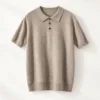

When contacting a knitted polo manufacturer, you can start with a reference photo or sample, your target quantity, colors, size range and the collar and placket look you want. You do not need to know the exact collar construction, placket method or gauge before contacting the factory. During sampling, the collar height and opening, placket depth, buttons, yarn, gauge, rib trims and fit can be confirmed together. Before bulk production, approve the measurements, color, stitch, logo, labels, packaging and the overall look against the sample.
You do not need to know the technical terms before the first conversation. Start with the look, fit, quantity and the reference you want the sample to follow.
Can You Make a Knitted Polo From My Reference Photo?
Yes. A clear reference photo or a physical sample is normally enough to open the discussion.
A good image shows the overall shape, the collar direction, roughly how deep the placket runs, the sleeve shape, the body fit, the stitch or pattern, and the general color direction.
Some details cannot be settled from an image. The exact yarn, gauge, final measurements, button details, final fit and final price all depend on decisions made during sampling. That is normal for a first knitted polo development.
If you do not know the exact collar construction or placket method yet, that is fine. You do not need a complete tech pack to start. A tech pack is helpful when you have one, and it can also be built up as the details are confirmed.
What Should Buyers Confirm About the Collar and Button Placket?
Collar and placket construction can vary by design, yarn, gauge and production method, so the useful starting point is the finished look rather than a technical name.
For the collar, the points worth confirming are the collar height, the collar opening, whether the finish should read folded, flatter or more open, and how the collar sits when the placket is open.
For the placket, the points worth confirming are the depth of the opening, the number of buttons, the button size, material and color if already decided, the button spacing, and the finished appearance of the front. Button spacing and position are easier to judge on a sample than on a drawing.
If you are comparing a knitted polo against a zip-neck style in the same range, the front is the main difference. A partial-zip neck closes with a zipper; a polo closes with buttons.
How Do Yarn and Gauge Affect the Look and Price?
Cotton and cotton blends are common options for knitted polos, and wool, wool blends and synthetic blends may also be used depending on the design. The yarn affects how the garment feels in the hand, how much it weighs, how the surface looks and what it costs. Cotton sweater manufacturing covers the cotton side in more detail.
Gauge changes how fine or how visible the knit texture appears. Finer gauges are often chosen when a cleaner, flatter knit surface is wanted; coarser gauges can create a more visible knit texture. The final appearance also depends on the yarn and stitch. What gauge changes about appearance, weight and cost explains the trade-off.
Yarn count and ply can also affect garment weight, appearance and price, so they should be considered together with gauge and stitch.
Send any yarn or fiber preference you already have. If you do not have one, a yarn can be proposed at sampling against your target weight and price.
 What Can Be Customized on a Knitted Polo?
 What Can Be Customized on a Knitted Polo?
Most parts of a knitted polo can be customized:
- Collar — collar style and collar height.
- Placket — placket depth, button number, and button material or color.
- Shape — sleeve length, body fit and body length.
- Trims — rib cuffs and hem, and side vents.
- Yarn and surface — yarn or fiber blend, gauge, color, and stitch or pattern.
- Branding — logo, labels and trims.
- Packing — packaging.
The combination that suits your range is reviewed before sampling, so none of these points has to be locked before the first conversation.
Does Collar and Placket Construction Affect Price?
Collar and placket details can affect the price, but they are only part of the final quote. The quote can also be affected by the yarn or fiber, garment weight, gauge, stitch or pattern, button and trim details, quantity, size range, number of colors, finishing and packaging.
If you already know the yarn, quantity and color plan, include them when requesting a quote.
What Is the MOQ for a Custom Knitted Polo?
Our starting MOQ is 100 pieces per style for suitable projects. Size and color allocation depend on the yarn, color plan and production requirements.
The actual MOQ can also be affected by yarn minimums, the number of colors, custom dyeing, buttons, trims and the production requirements of the style. The final quantity should therefore be confirmed for each project.
What Should You Check on the Sample Before Bulk?
The sample is where the collar, placket and rib decisions are confirmed or corrected. It is worth going through the garment in a fixed order.
- Does the collar shape match the reference?
- Is the collar height and opening correct?
- Does the collar sit properly when the placket is open?
- Is the placket depth correct?
- Are the buttons and buttonholes positioned correctly?
- Can the garment be put on and taken off comfortably with the placket used as intended?
- Are the cuff and hem ribs correct?
- Are the overall fit and measurements correct?
- Are the color, stitch, logo, labels and trims correct?
- Does the sweater still look right after the agreed wash?
Measurement points and methods should be agreed between the buyer and factory before production, so the same points are checked at sampling and before shipping. Two supporting guides are useful here: what to check when approving a sample and how measurement tolerance is applied at inspection.
How Do You Keep Bulk Production Close to the Approved Sample?
The approved sample, together with the agreed specification, should be used as the reference for bulk production.
The details worth recording on the specification are the yarn or fiber, the color, the gauge and stitch, the collar, the placket, the buttons, the measurements, the rib details, the logo and trims, the labels and the packaging.
If any key construction, yarn or trim changes after approval, confirm the change between the buyer and factory before bulk production. Depending on the change, a revised sample or written approval may be needed.
What Should You Send for a Knitted Polo Quote?
 What Should You Send for a Knitted Polo Quote?
A quote is easier to prepare when the brief covers the commercial side as well as the look. The list below is a useful starting point.
- Reference photo or physical sample
- Target quantity
- Size range
- Colors
- Collar look
- Placket depth or button preference, if known
- Preferred yarn or fiber, if known
- Logo
- Labels
- Trims
- Packaging
- Target budget, if available
If you already have a tech pack, include it. If not, a reference image is enough to start.
Send Us Your Knitted Polo Design
If you have a knitted polo reference, send us the image together with your target quantity, size range, colors, desired fit, preferred yarn or fiber if known, and any logo, label or packaging requirements. If the collar style, placket depth or exact gauge has not been decided yet, that is fine. Those details can be reviewed with you before sampling and quoting. Our knitwear manufacturing service shows how a program runs from brief through to bulk.