
What Is Sweater Gauge and Why It Matters for B2B Sourcing
Gauge refers to the number of needles per inch on a flat knitting machine. A 12-gauge (12G) machine has 12 needles per inch; a 3-gauge (3G) machine has 3. Gauge influences the range of yarn thicknesses and stitch structures a machine can handle. Together with yarn count, fibre, stitch construction and knitting settings, it affects the garment’s appearance, weight, hand feel and production requirements.
For B2B buyers, gauge is not just a technical specification — it is a design, cost, and positioning decision. Choosing the wrong gauge for a collection can result in a sweater that looks too heavy for spring, costs too much for the target retail price, or fails to match the brand’s aesthetic. Understanding gauge helps buyers write clearer design briefs, evaluate factory quotations more accurately, and avoid sampling rounds that start from a mismatched specification.
 Quick Gauge Reference Table
 Quick Gauge Reference Table
| Approx. Gauge Range | General Visual Direction | Yarn Consideration | Typical Design Direction |
|---|---|---|---|
| 3G–5G · Coarser gauges | Larger, more visible stitches | Often paired with thicker yarns; compatibility depends on yarn count, ply and machine | Chunkier textures, bold stitches, pronounced structures |
| 7G–10G · Mid gauges | Balanced stitch definition | Supports a broad range of yarn and stitch options depending on machine setup | Everyday sweaters, textured knits, varied patterns |
| 12G–14G · Fine gauges | Smaller, denser-looking stitches | Often developed with finer yarns, subject to yarn and machine compatibility | Refined surfaces, finer patterns, lightweight constructions |
| 16G–18G+ · Very fine gauges | Smooth, compact visual effect | Requires suitable fine yarn and compatible machinery | Fine knitwear and detailed lightweight structures |
These gauge ranges are practical reference groupings rather than universal industry classifications. Gauge-to-yarn relationships should also be treated as development guidelines rather than fixed rules. Actual machine gauges, yarn compatibility and suitable constructions vary by supplier, machine model, yarn count, ply, fibre and stitch structure.
How Gauge Shapes a Sweater’s Appearance
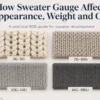
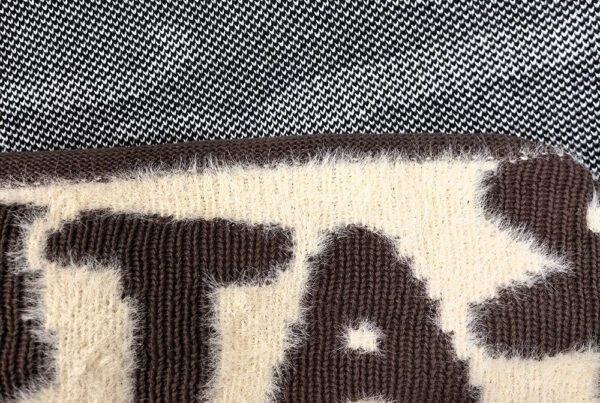
The most immediate effect of gauge is visual: it influences stitch scale and surface texture. Coarser gauges create a larger stitch scale and make individual stitches more visually prominent. Finer gauges create a smaller stitch scale and can produce a smoother-looking surface. The final appearance also depends on yarn, stitch structure, knitting density and finishing.
Gauge also influences which stitch patterns are practical. Coarser gauges often create more pronounced cable relief, while finer gauges can produce smaller and more refined cable structures. The final effect depends on yarn thickness, cable width, stitch layout and machine setup. Higher gauges can provide more stitch positions within a given area, which may help reproduce finer details in jacquard and intarsia patterns. However, these techniques can be developed across a range of gauges. The suitable gauge depends on the artwork, yarn, motif size, machine capability and the desired fabric effect. Rib structures are possible across most gauges, but the visual effect changes significantly: a coarser rib looks thick and architectural; a finer rib is more delicate and used more for fit than visual impact.
If a gauge has already been specified, include it alongside the design reference. If not, ask the factory to review the artwork, yarn direction and target fabric effect before recommending a gauge. A cable sweater designed at a coarser gauge will look and feel different from one produced at a finer gauge — even with the same yarn type. If a reference image shows a coarser knitted structure but the tech pack specifies a much finer gauge, the finished result may not match the visual reference without further adjustment. The factory should review the gauge, yarn and stitch structure together before sampling. Aligning these inputs early avoids wasted development time.
How Gauge Affects Fabric Weight and Drape
Lower-gauge machines have fewer needles per inch and are often used with thicker yarns, which can create larger, more visible stitches. Coarser-gauge designs frequently use thicker yarns and may produce heavier garments, while finer gauges can support lighter constructions. Finished garment weight, however, cannot be estimated from gauge alone. It also depends on yarn count, fibre, stitch structure, knitting density, garment size, pattern elements such as cables or jacquard, and finishing processes. This weight difference directly affects shipping costs, retail price positioning, and seasonal suitability.
Drape — how the fabric hangs on the body — follows from weight and stitch density, but gauge alone does not determine it. Coarser-gauge knits often drape with structure and may hold their shape well. Finer-gauge knits may drape more fluidly, following body contours more closely. Yarn count, fibre, stitch structure, knitting density, garment dimensions and finishing all affect how the fabric hangs and moves.
For buyers planning multi-season collections, coarser constructions are often used when a heavier, more textured or insulating result is wanted. Fine and mid-to-fine gauges may be considered for lighter knitwear, but seasonal suitability also depends on fibre, yarn count, stitch openness, garment weight and construction. A single yarn — merino wool, for example — can produce noticeably different seasonal weights just by changing the gauge and stitch construction.
The Cost Implications of Gauge Choice
Gauge affects production cost through three main channels: yarn consumption, machine type, and knitting time.
Yarn consumption. Coarser gauges are often developed with thicker yarns, but yarn consumption still depends on garment dimensions, stitch structure, density and yarn count. Gauge can affect material cost indirectly because it influences yarn selection, stitch density and construction. Finished yarn consumption still depends on garment dimensions, yarn count, stitch structure and design. Even when the per-kilogram yarn price is similar, the material cost per piece can differ substantially — a factor that becomes significant with premium fibers such as cashmere or extra-fine merino.
Machine type and availability. Different gauge ranges require different machine configurations. Machine availability varies by supplier, and the available gauge range may differ between factories and machine models. Buyers should confirm that the manufacturer has suitable equipment and production capability for the required gauge before sampling and bulk production.
Knitting time. Gauge can influence knitting time, but it does not determine it on its own. Total machine time also depends on garment dimensions, stitch structure, transfers, pattern complexity, yarn handling, carriage speed and machine model. The factory should evaluate knitting time from the actual program and sample rather than from gauge alone.
The cost relationship across gauges is not linear. Rather than choosing a gauge for cost reasons alone, buyers should treat gauge as a design input that carries cost implications — and discuss trade-offs with the factory during sample development.
Choosing the Right Gauge: A Decision Checklist
Use the following checklist when selecting gauge for a new sweater product:
- Target season and climate. Consider the intended season together with gauge, yarn, fibre, stitch structure and target garment weight.
- Desired visual direction. Decide whether the collection needs bold visible stitches, a balanced knitted texture or a fine, smooth surface. Brand positioning should be evaluated together with yarn quality, garment construction, finishing and overall design rather than gauge alone.
- Design features. Does the design include cables, jacquard patterns, or placement embroidery? Different techniques respond differently to gauge, yarn and stitch scale. Confirm that the selected gauge can reproduce the required structure and artwork before finalizing the design.
- Yarn selection. Which yarns are candidates? Check whether the selected yarn is compatible with the proposed gauge and stitch structure. Yarn count, ply, fibre, machine setup and construction all affect the workable range.
- Target EXW/FOB cost. Estimate backward from the target retail price to the allowable EXW/FOB cost, then check whether the preferred gauge-yarn combination fits. If not, adjust the gauge, yarn, or design complexity.
- Shipping weight. Heavier garments cost more to ship. For distant markets or thin-margin products, include gauge-related weight differences in the logistics calculation.
- Factory gauge availability. Confirm that the factory has suitable equipment and production capability for the required gauge before finalizing the design brief.
What to Prepare Before Discussing Gauge with a Manufacturer
When contacting a sweater factory about a new product, providing the following helps the technical team assess gauge requirements accurately:
- Reference images or design sketches showing the desired stitch size, texture, and overall silhouette.
- Target yarn type and count — if a specific yarn is already selected, share the yarn count (Nm or Ne). If not, describe the desired hand feel and weight.
- Intended season and wearing occasion — helps the factory confirm whether the suggested gauge is appropriate for the end use.
- A physical reference sample — even a sweater from another brand — can help communicate the intended stitch scale, texture and overall fabric effect more clearly.
- Target EXW/FOB cost range — allows the factory to suggest gauge-yarn combinations that stay within budget before sampling starts.
A common issue during sample development is a mismatch between the buyer’s visual reference and the specified gauge or knit structure. Aligning the visual reference, yarn specification, and target gauge early prevents unnecessary sample rounds.
Frequently Asked Questions
Q: Can the same sweater design be produced at different gauges?
A: Yes, but the result will look and feel different at each gauge. A cable sweater produced at 7G has bold, prominent cables; the same design at 12G produces finer, subtler cable definition. The overall proportions and silhouette may also shift because fabric weight and drape change. We recommend producing a sample at one gauge first, evaluating it, and then deciding whether an alternative gauge is needed.
Q: Does a higher gauge mean better quality?
A: No. Gauge and quality are independent. A well-made 3G chunky knit with consistent stitches, clean linking, and proper finishing is a quality garment. A poorly made 14G sweater with uneven tension and rushed finishing is not. Quality depends on yarn grade, stitch consistency, linking, and finishing — not on how many needles per inch the machine has.
Q: What gauge works best for a lightweight summer sweater?
A: Fine and mid-to-fine gauges are often considered for lightweight knitwear, but the final garment weight also depends on yarn, fibre, stitch structure, density and garment dimensions. Depending on the yarn and construction, gauges such as 12G or finer may be considered for many lightweight developments.
Q: Does gauge affect minimum order quantity?
A: Gauge does not directly determine MOQ. MOQ is usually influenced by yarn sourcing and production setup requirements. Machine availability and gauge-specific capacity can also vary by supplier, so buyers should confirm whether the required gauge has suitable production capacity before placing an order.
Q: Can multiple gauges be combined in one sweater design?
A: It can be possible, but feasibility depends on the garment construction and available machine setup. In some cases, separate components may be knitted on different machines and then assembled. Feasibility should be confirmed with the manufacturer before development. Mixed-gauge effects may require additional programming, component planning or assembly considerations depending on the construction.
Q: What if I do not know which gauge to choose for my design?
A: Start with your reference image and target season. Send both to the factory along with your target price range and intended use. An experienced technical team can suggest one or two gauge options, explain the trade-offs, and recommend which to sample first. You do not need to decide the gauge before contacting a factory — it is a normal part of the product development conversation.
Planning a sweater collection and need to determine the right gauge for each piece? Send us your design references, target yarn preferences, intended season, and approximate quantity. Our technical team can review the designs and suggest gauge options that balance appearance, weight, and cost for your collection.
We work with reference images, design sketches, material preferences, target quantity, size range, color direction, and desired delivery timeline. Reach out with your project details and we will provide a production proposal based on your specific requirements.