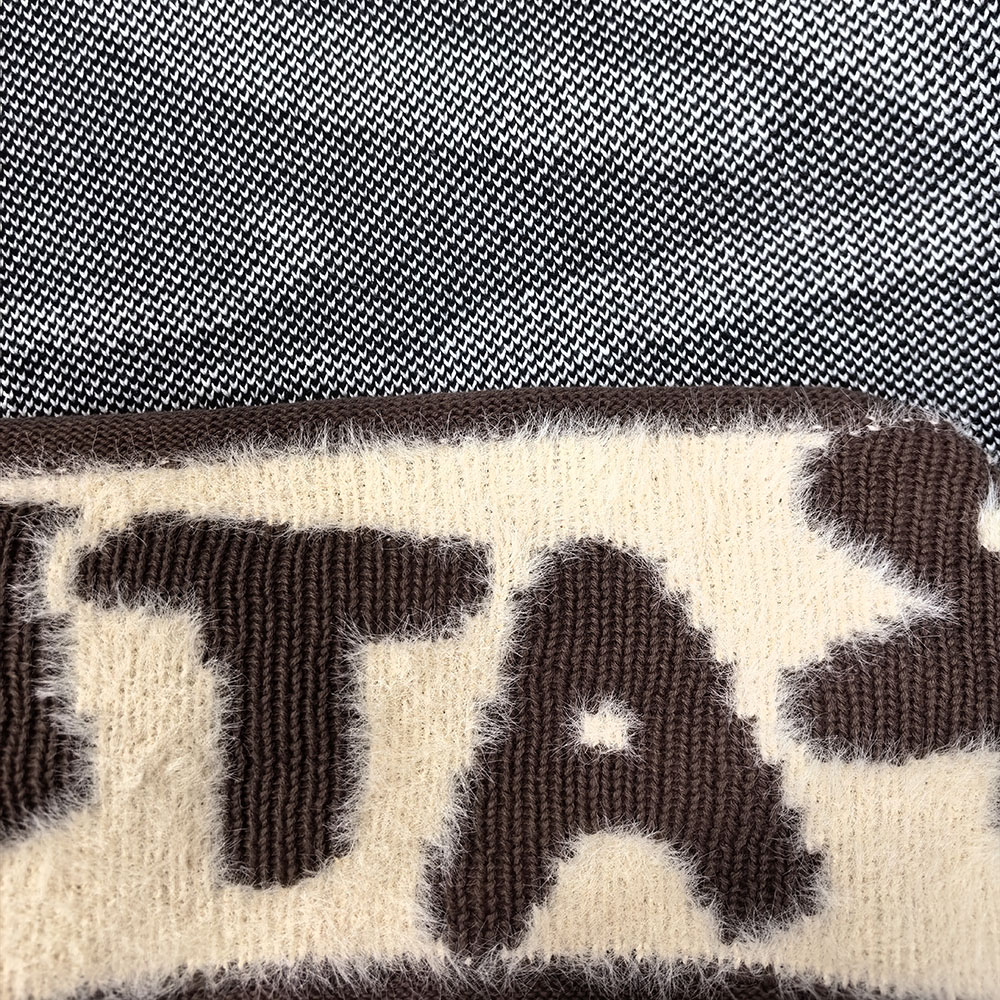
When a fashion brand sends a sweater design with color graphics, choosing between jacquard vs intarsia knitwear starts with the structure of the design itself. The factory reviews how the artwork could be knitted rather than asking which technique is “better.” The question is what the design requires from the knitted structure. A repeating geometric pattern and a large chest graphic may both use several colors. However, they place different demands on yarn management, reverse-side construction, fabric weight and stretch. This article walks through the design factors that help a buyer and manufacturer evaluate whether a given artwork points toward jacquard, intarsia or a combination that requires further discussion before sampling.
For context on what happens once a knit structure is chosen, see our custom sweater sampling process guide.
 Jacquard and Intarsia in Simple Terms
Jacquard knitwear forms patterns through the knitting program. The program controls which needles knit each yarn at different positions across the fabric. Multiple colors or stitch structures can appear in the same row or course, controlled by the machine’s patterning system. This approach often works well for repeating motifs, geometric patterns and all-over graphics. It can also suit repeated logos or continuous patterns across the garment.
Intarsia forms separate color fields using yarn carriers assigned to defined areas of the pattern. Unlike many jacquard constructions, unused colors generally do not need to travel across long sections behind the motif. This approach can work well for large isolated motifs, defined color blocks, large lettering, front or back graphics concentrated in one area and designs where the motif does not repeat across the entire garment. Intarsia and jacquard are different knitted construction approaches — neither is automatically more advanced or more premium. The question is which one fits the specific artwork, placement and garment requirements.
What Changes on the Inside of the Sweater?
One of the most practical differences between jacquard and intarsia shows up on the reverse side of the fabric — and that reverse structure affects thickness, weight, stretch and hand feel.
With jacquard construction, the reverse side depends on how the specific jacquard structure manages unused yarn. In some jacquard types, yarn not required on the face is carried as floats across the back of the fabric. Other jacquard structures use a backing yarn or knit the unused color into the reverse in a way that controls float length and appearance. The chosen structure can influence fabric thickness, insulation, stretch behavior and how the garment feels against the body. A heavier reverse structure adds weight and warmth; a lighter one may drape differently.
With intarsia, separate yarn supplies feed each color block independently. For large placement areas, this means unused colors do not need to be carried across long distances behind the motif. During sample review, the areas to check include color joins — where two color blocks meet — for holes, gaps or uneven tension. The reverse side should also be inspected: how the joins look, whether the motif shape reads cleanly from the back and whether tension is consistent across color boundaries. These details affect not just appearance but also how the garment holds its shape during wear.
Which Artwork Works Better With Each Technique?
A useful way to approach the decision is to look at the artwork itself — its repeat, placement, scale, number of color areas and how colors interact within the design.
Small repeated geometric pattern across the sweater body</strong>
When a motif repeats continuously across the fabric — such as a diamond, houndstooth or Scandinavian-style pattern — jacquard is often the natural starting point. The repeat structure, pattern distribution and continuity across the garment width align with how jacquard machines manage yarn and stitch selection. The technical review still needs to confirm the repeat scale, color arrangement and gauge.
Large single chest graphic or front placement motif
A graphic concentrated in one area — a large crest, character, lettering or abstract shape — may make intarsia worth considering first. The isolated nature of the graphic, where colors appear only within a defined zone, fits the block-based yarn management of intarsia. That said, the final decision depends on the graphic detail, the number of color blocks, how colors meet at the edges and the required reverse-side appearance.
Large lettering across the front
Lettering sits in between. Some lettering designs — especially those with bold, continuous color blocks and simple edge shapes — can be developed with intarsia. Fine lettering may need more adjustment. Narrow internal spaces, tight spacing or complex serif edges can require simplification before the knitting technique is confirmed. Line thickness, spacing, letter size relative to stitch resolution and the number of color changes within a small area all affect feasibility.
Repeated small motifs plus one large central graphic
A design that combines both — a repeating border pattern and a large center motif, for example — may need different construction approaches for different areas, or may need the artwork adjusted so the full design can be produced consistently. Some designs should be reviewed with the manufacturer and potentially adjusted before committing to one knitting structure.
How Gauge, Yarn and Artwork Affect the Result
Even when artwork looks sharp on a screen, the knitted outcome is shaped by gauge, yarn thickness, yarn composition and surface texture — all of which affect stitch resolution and how clearly a motif reads.
Gauge influences how many stitches and rows fit into a given area, which in turn affects the level of detail that can be knitted into a motif. Yarn thickness and composition also affect the result. Thicker yarns produce larger stitches, while hairy or slub yarns can soften color boundaries. A vector graphic with crisp lines and small details may need adjustment when translated into a knitting program. Shapes and color boundaries are mapped onto a stitch grid, so very fine lines, narrow gaps and small internal spaces may need simplification.
Fine lines and narrow gaps often need review during knitting development. Small spaces inside lettering and complex color boundaries may also need adjustment. A motif that reads clearly at one garment size or gauge may need adjustment when the garment size, gauge or yarn changes, because the available stitch grid and motif proportions also change. Reviewing artwork alongside the intended gauge, yarn and garment measurements before sampling helps identify potential issues early. For a deeper look at how yarn choice affects knitted results, our sweater yarn materials guide covers fiber types and their properties in production.
Jacquard vs Intarsia Knitwear: Practical Comparison
The table below compares the two approaches across factors that matter during design review and sample development. Neither column represents a fixed rule — each point should be checked against the specific artwork, yarn, gauge and garment construction for the project.
| Factor | Jacquard | Intarsia |
|---|---|---|
| Typical use | Repeating or broader patterned areas | Large isolated motifs or defined color blocks |
| Pattern placement | Often suited to repeated or continuous patterned areas | Often suited to specific placement graphics |
| Reverse-side construction | Depends on the jacquard structure and how unused yarn is managed | Separate color areas may reduce the need to carry unused yarn across large sections |
| Fabric feel and weight | Can vary with the jacquard type, yarn management and backing structure | Can vary with the number of color areas, yarn choices and join construction |
| Stretch behavior | Affected by the knit structure, float management and backing yarn if present | Affected by the base knit structure, join tension and color-block layout |
| Artwork preparation | Review repeat, scale, color arrangement and stitch structure | Review placement, color blocks, joins and graphic shape |
| Pattern repeat | Suited to designs that repeat across the fabric width | Not typically used for repeating patterns across the full width |
| Large isolated graphics | May need evaluation of yarn management and reverse structure for concentrated motifs | Can work well for large graphics concentrated in defined areas |
| Color joins | Color changes are managed by the knitting program and structure | Color joins where blocks meet need careful tension and construction review |
| Key sample checks | Pattern alignment, tension, fabric feel, reverse structure and repeat accuracy | Color joins, graphic shape, placement accuracy and tension across blocks |
| How to decide | Review the artwork together with gauge, yarn, garment construction and sample result. Neither technique is automatically better. | |
How We Review Artwork Before Sampling
When a buyer sends a sweater design, the technical review looks at how the artwork interacts with the knitted structure — not just whether the graphic “looks good” on a screen.
During this stage, the team evaluates motif dimensions, placement, repeat requirements, color areas and how colors interact at boundaries. Yarn, gauge and garment measurements are reviewed alongside the artwork. Each can affect how the motif translates into stitches. The intended reverse-side appearance and stretch expectations are also considered — a graphic that works on the face may create a reverse structure that affects drape or comfort.
Buyers may provide a reference image, design drawing, tech pack, physical sample or measurement chart. Each type of input gives different information, and the review adapts accordingly. A design drawing may show the intended graphic clearly but not contain the knitted construction information needed to confirm gauge or yarn count. A reference image or physical sample may provide more construction clues but may not match the buyer’s intended material or size range exactly.
After the review, the discussion with the buyer covers whether the design points toward jacquard, intarsia, another suitable knitting approach, or whether the artwork should be adjusted before sampling. For more on how artwork moves from design to sample, our sweater sample development guide walks through the full process.
What Affects Cost?
Cost differences between jacquard and intarsia are not fixed — they depend on the specific project variables. Cost is influenced by several project variables. These may include artwork complexity, color arrangement, yarn, gauge, knitting structure, programming and sample development requirements.
Garment size can affect motif dimensions, stitch count, yarn consumption and knitting time, especially when the artwork scales with the garment. Size alone does not necessarily change the number of color areas. Order quantity can affect how development work is distributed across an order, but quantity alone does not determine which technique is more economical. The right approach is to evaluate the complete set of project requirements rather than relying on a price comparison between two technique names.
What to Send Your Manufacturer Before Choosing a Technique
If you are unsure whether a design should be developed with jacquard or intarsia, do not try to decide from the artwork alone. Send the materials to the manufacturer for a technical review. The most helpful items to include:
- Artwork or reference image showing the intended graphic
- Motif dimensions and placement on the garment
- Color references for each area of the design
- Yarn preference or target fiber composition
- Garment measurements or size range
- Target quantity
- Desired reverse-side appearance if relevant
- Stretch or hand-feel requirements where they affect the design
HDL Fashion supports development from reference images, design drawings, tech packs, physical samples and measurement charts. If you are preparing to request a quote, our quote information checklist outlines what helps produce an accurate production proposal.
Frequently Asked Questions
Is intarsia the same as jacquard?
No. Both are knitted colorwork approaches, but they manage multiple yarn colors differently. Jacquard uses the knitting program to control which yarn knits at each position, allowing patterns with multiple colors and frequent color changes within a row. Intarsia generally works with separate yarn areas for defined color fields, so unused colors do not normally need to be carried across long sections behind the motif. The structural difference affects how patterns are formed, how the reverse side is constructed and which types of artwork each approach suits.
Which technique is better for a large sweater logo?
Large isolated graphics often make intarsia worth considering, but the final decision depends on more than the size of the graphic. The factory still needs to review the artwork detail, color blocks and yarn choice. Gauge, placement and the desired reverse-side appearance also matter. A logo with fine lines or tight internal spaces may need artwork adjustment before either technique is confirmed.
Which technique works better for repeating patterns?
Repeating or all-over patterns often point toward jacquard. Their repeat structure works naturally with continuous pattern distribution across the knitted fabric. That said, the repeat scale, color arrangement, gauge and knit construction still need technical review before the approach is confirmed.
Can jacquard and intarsia be used in the same sweater?
Depending on the garment construction, artwork layout and machine capability, different approaches may sometimes be combined or used in different areas of the same garment. Whether this is feasible for a given design depends on the specific artwork, placement, gauge and production setup. This is something to discuss with the manufacturer during the technical review stage.
Does gauge affect jacquard and intarsia designs?
Yes. Gauge affects stitch resolution, which influences how much detail can be reproduced in a knitted motif. It also affects yarn choice, fabric weight and how the pattern appears in the finished garment. A design intended for one gauge may need adjustment if the garment is produced at a different gauge, so gauge should be discussed early in the development process.
What should I send the factory before choosing jacquard or intarsia?
Send the artwork or reference image, motif dimensions and garment placement, color references, yarn preference, garment measurements or size range and target quantity. If the design has specific reverse-side or stretch requirements, include those as well. The manufacturer can then review the materials and discuss which knitting approach fits the design before sampling begins.
Start With Your Design, Not a Technique Name
Jacquard and intarsia solve different design problems in knitted garments. Repeated or broader patterns often point toward jacquard as a starting point, while large isolated placement graphics often make intarsia worth considering first. But the right approach is not determined by a rule of thumb — it comes from reviewing the artwork, yarn, gauge, garment construction, reverse-side requirements and sample result together.
If you have a sweater design and are not sure which knitting method fits it, send the artwork, reference image or tech pack for a technical review before sampling. Our team at HDL Fashion — a custom knitwear and sweater manufacturer with 20+ years of experience — can evaluate your design and discuss the development approach that matches your project.
Contact us with your design details to start the review.