Knitwear Grading Logic: How Fully Fashioned Sweaters Are Sized
In custom knitwear manufacturing, sweater grading is not simple pattern scaling.
Woven garments usually use 2D pattern grading to enlarge or reduce base patterns. Fully fashioned knitwear follows a different production logic.
A sweater is shaped directly on a flat knitting machine, needle by needle and row by row. Therefore, knitwear grading logic depends on stitch allocation, course rows, machine gauge, stitch density, and shaping transfers.
If manufacturers apply the same shaping ratio across all sizes, fit problems can appear. A larger sweater may have a wider chest but still feel tight around the armhole.
For apparel buyers and sourcing teams, understanding needle allocation and grading formulas helps evaluate tech packs, size sets, and pre-production samples.
1. How Knitwear Grading Differs from Woven Pattern Grading
The fundamental difference comes from how the garment structure is created.
Woven garments start with fabric sheets and use cut patterns. Fully fashioned knitwear creates garment dimensions directly through knitting.
The basic grading logic can be summarized as follows:
Woven Garment Grading
[ Base Pattern ]
       ↓
Uniform 2D Pattern Expansion
       ↓
[ Larger Pattern ]

Fully Fashioned Knitwear Grading
[ Chest Width ]
       ↓
Recalculate Active Needles
(Gauge × Width)

[ Armhole Depth ]
       ↓
Recalculate Course Rows
(Row Density × Height)

[ Shaping Curves ]
       ↓
Redistribute Needle Transfers
(Narrowing / Widening)
This means each size requires structural recalculation rather than simple proportional enlargement.
Key Variables in Knitwear Size Grading
The main technical variables include:
- Machine gauge
- Active needle count
- Stitch density
- Course row density
- Chest width
- Armhole depth
- Neck width
- Shoulder width
- Needle narrowing
- Needle widening
- Yarn tension
- Wash shrinkage
These variables determine how the knitted structure changes between sizes.
2. Knitwear Grading Formulas for Armhole Depth
Armhole depth is one of the most important grading dimensions because it affects upper-body mobility and fit.
The original sizing framework uses different formulas for women’s and men’s garments.
Women’s Armhole Depth Formula
Armhole Depth (cm)=Bust Circumference10+12.5 cm\text{Armhole Depth (cm)} = \frac{\text{Bust Circumference}}{10} + 12.5\text{ cm}
Men’s Armhole Depth Formula
Armhole Depth (cm)=Chest Circumference10+13.5 cm\text{Armhole Depth (cm)} = \frac{\text{Chest Circumference}}{10} + 13.5\text{ cm}
These formulas provide a starting point for recalculating armhole dimensions across sizes.
Example: Grading a Men’s Sweater from M to L
Consider a men’s sweater with the following chest measurements:
- Size M: 100 cm chest
- Size L: 108 cm chest
Using the stated formula:
- Size M armhole depth = 23.5 cm
- Size L armhole depth = 24.3 cm
The knitting operator must then convert the dimensional change into additional course rows.
The operator must also adjust the frequency of needle transfers to maintain the armhole curve.
For example, the shaping sequence may change from a 2-row drop sequence to a 4-row drop sequence.
The key point is that the machine must reproduce the new armhole geometry rather than simply enlarge the original shape.
3. Neck Width and Shoulder Needle Allocation
Armhole grading is only one part of a complete knitwear size grading system, neck width and shoulder slope must also maintain proportional relationships across sizes.
Neck Width Allocation
Neck width typically increases gradually between sizes.
The stated grading range is approximately:
0.5 cm–1.0 cm per size
This increase can be achieved by adding active needles to the center bind-off section.
The exact needle allocation should correspond with the approved garment measurements and construction.
Shoulder Drop Ratio
Shoulder width also increases as garment size increases.
Instead of creating one steep shoulder angle, manufacturers can divide shoulder needle transfers into balanced steps.
One example is:
Bind off 4 needles every 2 rows across 6 steps.
This creates a more controlled shoulder slope and supports natural garment drape.
4. Needle and Row Allocation in Fully Fashioned Knitwear
Fully fashioned knitwear depends on two primary structural dimensions:
| Grading Dimension | Technical Control | Manufacturing Variable |
|---|---|---|
| Width | Active needle count | Gauge × garment width |
| Height | Course row count | Row density × garment height |
| Armhole | Needle transfer frequency | Narrowing sequence |
| Neckline | Center needle allocation | Bind-off structure |
| Shoulder | Step-down transfers | Needle distribution |
| Shape | Narrowing and widening | Transfer frequency |
This explains why knitwear grading cannot rely on uniform percentage scaling.
A dimensional change must be translated into specific needle and row changes.
5. Woven Pattern Scaling vs. Fully Fashioned Knitwear Grading
The two manufacturing systems use fundamentally different grading units.
| Sourcing & Technical Parameter | Traditional Woven Pattern Scaling | Fully Fashioned Knitwear Size Grading |
|---|---|---|
| Primary Unit | Millimeters / inches on flat patterns | Needles and course rows |
| Curvature Control | Smooth continuous grading lines | Stepped needle transfers |
| Main Variables | Fabric weight and stretch | Gauge, stitch tension, and wash shrinkage |
| Common Sizing Flaws | Proportional scaling distortion | Distorted armholes or tight sleeve crowns |
| Sample Verification | Usually base-size sample | Multi-size fit samples |
This difference is especially important when buyers compare woven apparel development with fully fashioned sweater production.
6. Why Static Transfer Ratios Create Fit Problems
One common sourcing mistake is approving only one base-size sample.
A Size M sweater may fit correctly while the same grading logic produces poor fit in Size S or XXL.
The problem occurs when the factory applies a static shaping ratio instead of recalculating the structural transfer sequence.
Base Size Sample Approved
        ↓
Static Transfer Ratio Applied
        ↓
 ┌───────────────────────┐
 │                       │
 ▼                       ▼
Size S                  Size XL
Armhole Too Deep        Armhole Too Tight
Excess Underarm        Restricted Movement
Fabric                  Around Shoulder
This is why size-set verification should evaluate both measurements and garment mobility.
7. Buyer Guide: How to Verify Knitwear Grading Before Bulk Production
Apparel procurement teams can use multi-size fitting tests to identify grading problems before bulk manufacturing.
Step 1: Request Extreme-Size Prototypes
Instead of checking only the base size, request physical samples from two distinct sizes.
A practical example is:
Size S + Size XL
Testing the two ends of the size range helps reveal whether the factory recalculated shaping correctly.
Step 2: Check Armhole Mobility
Test movement in the larger size.
The armhole should provide sufficient mobility without creating excessive fabric under the arm.
This helps identify whether the factory increased armhole depth through proper needle and row allocation.
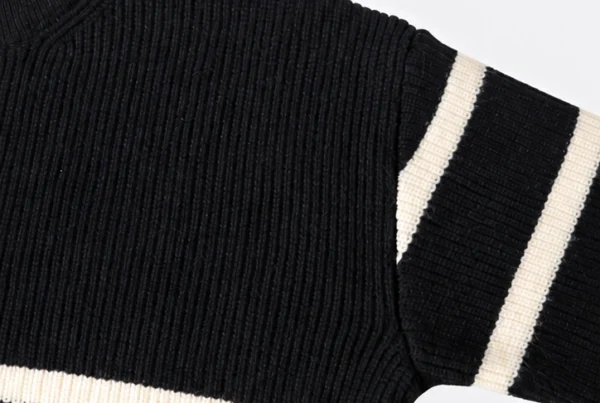
Step 3: Inspect Needle Transfer Lines
Check the narrowing marks along raglan or armhole seams.
The transfer lines should remain:
- Crisp
- Straight
- Parallel to the seam
- Free from obvious puckering
Poor transfer distribution can reveal grading problems even when basic garment measurements appear correct.
Step 4: Compare Size Measurements
Buyers should compare the approved tech pack with physical samples.
Important dimensions include:
- Chest width
- Armhole depth
- Neck width
- Shoulder width
- Sleeve dimensions
- Garment length
The purpose is to verify that dimensional changes correspond with the intended grading logic.
8. Multi-Size Sampling for Custom Knitwear
A single base-size sample cannot fully validate a size run.
For custom knitwear projects, a multi-size sample set can help identify:
- Armhole distortion
- Incorrect shoulder slope
- Excess underarm fabric
- Restricted shoulder movement
- Inconsistent neckline proportions
- Irregular fashioning marks
For sourcing teams, testing Size S and Size XL provides a practical way to evaluate grading at different points in the size range.
9. Frequently Asked Questions About Knitwear Grading
What is knitwear grading logic?
Knitwear grading logic is the process of adjusting needles, course rows, and shaping transfers across garment sizes.
It differs from conventional woven pattern scaling because fully fashioned sweaters are constructed directly through knitting.
Why can a larger sweater still feel tight around the armhole?
A larger chest measurement does not automatically guarantee a correctly graded armhole.
If the factory does not recalculate armhole depth and needle transfer frequency, the larger size can restrict shoulder movement.
How much should knitwear neck width increase between sizes?
The stated grading range is approximately 0.5 cm–1.0 cm per size.
The actual allocation should follow the approved garment measurements and construction requirements.
Should buyers test more than one knitwear size?
Yes. The original sourcing protocol recommends testing distinct sizes, such as Size S and Size XL, rather than relying only on a base-size sample.
What should buyers inspect on a fully fashioned sweater?
Buyers should review garment measurements, armhole mobility, shoulder slope, neckline proportions, and needle transfer marks across the size range.
10. Key Takeaways for Custom Knitwear Grading
Knitwear grading logic is based on structural needle and row allocation, not simple pattern scaling.
The main principles are:
- Recalculate active needles when garment width changes.
- Recalculate course rows when garment height changes.
- Adjust needle transfer frequency for armhole and shoulder shaping.
- Apply size-specific armhole calculations rather than static transfer ratios.
- Check neck and shoulder proportions across the size range.
- Use multi-size physical samples to verify the grading result.
- Inspect fashioning marks and garment mobility before bulk production.
For apparel buyers, these checks help identify grading errors before they affect the full production run.
Conclusion
Fully fashioned sweater sizing requires a different approach from traditional woven pattern grading.
Machine gauge, stitch density, course rows, active needles, and narrowing or widening transfers all influence the final fit.
A reliable knitwear grading logic therefore converts every size change into a controlled structural adjustment.
By reviewing grading formulas, checking needle allocation, and testing different sizes before bulk production, apparel buyers can reduce fit anomalies and improve consistency across the complete size range.