Many fashion brands assume that ordering 100 custom knitwear pieces should be enough for a small production run. However, a knitwear MOQ often depends on much more than the number of finished garments. Yarn quantity, color selection, fiber type, knitting technique, and production setup can all determine the actual minimum order quantity.
The reason starts with a fundamental difference between knitwear and woven clothing: knitwear production uses yarn as the primary raw material rather than finished fabric. Yarn suppliers also have their own minimum order requirements. When a brand needs only a small quantity of a particular yarn color, the unused material and sourcing costs can significantly increase the effective MOQ.
Understanding this process can help brands plan their first custom knitwear order more efficiently and avoid unexpected production costs.
Why Is the MOQ for Knitwear Higher Than Expected?
For a custom knitwear manufacturer, the production process begins with yarn procurement rather than simply purchasing pre-made fabric.
A typical order may involve several stages:
-
Yarn selection
-
Yarn procurement
-
Color matching
-
Knitting programming
-
Panel or garment knitting
-
Linking and assembly
-
Washing and finishing
-
Quality inspection
-
Packaging
Each stage can influence the minimum commercially viable production quantity.
Knitwear Uses Yarn Instead of Finished Fabric
This is one of the most important differences between knitted and woven garments.
A woven garment manufacturer can often purchase fabric by the roll and cut multiple garment sizes and styles from the same material. Knitwear manufacturers work directly with yarn to create the knitted structure.
Therefore, a custom knitwear order may require the factory to purchase a specific yarn composition and color before production begins.
If your order only requires a small amount of that yarn, the yarn supplier may still require a much larger minimum quantity.
Yarn Suppliers Have Their Own MOQ
The factory’s garment MOQ does not always equal the yarn supplier’s MOQ.
For example, suppose one custom sweater requires approximately 300 grams of yarn. An order of 100 sweaters may require around 30 kg of yarn before accounting for production losses and additional requirements.
If the yarn supplier requires a larger minimum quantity, the factory must purchase the remaining yarn even though the brand does not need all of it.
That unused material creates additional inventory and sourcing costs.
As a result, the manufacturer may increase the order quantity or adjust the unit price to make the project commercially viable.
How Yarn Type Affects Knitwear MOQ
Not all yarns have the same sourcing requirements.
The material selected for a custom knitwear project can significantly affect MOQ, lead time, and production cost.
Standard Cotton Yarn
Cotton yarn is widely used for sweaters, cardigans, pullovers, children’s knitwear, and lightweight fashion pieces.
Because common cotton yarns are produced in relatively large volumes, manufacturers may have more sourcing flexibility.
This makes standard cotton yarn a practical option for brands developing small or medium production runs.
Wool and Wool Blends
Wool and wool-blend yarns can have more specific sourcing requirements.
Different fiber percentages, yarn counts, colors, and finishing requirements may reduce the available sourcing options.
Brands should therefore confirm yarn availability before setting a target garment quantity.
Cashmere and Fine-Gauge Luxury Yarns
Luxury fibers such as cashmere typically require more careful sourcing and quality control.
Fine cashmere yarn can have a significantly higher MOQ than standard cotton yarn, especially when the brand requests a specific color, yarn count, or fiber specification.
This is why a small order of premium cashmere knitwear may not necessarily have a low total production requirement.
For luxury brands, the material itself can become one of the most important MOQ considerations.
Does Every Color Have a Separate MOQ?
In many custom knitwear projects, yes.
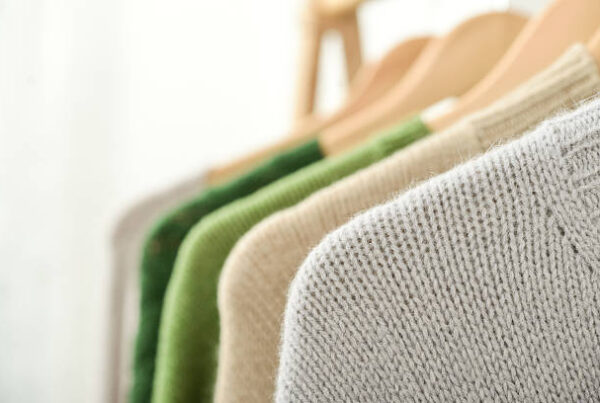
Color selection can have a major impact on the effective MOQ because each color may require separate yarn procurement.
For example, imagine a brand wants to produce:
-
100 black sweaters
-
100 cream sweaters
-
100 green sweaters
-
100 blue sweaters
The total order is 400 pieces.
However, the factory may need to source four separate yarn colors. If each color has its own yarn MOQ, the factory cannot simply treat the entire order as one 400-piece production run.
This is why 300 pieces per style and color can be a more practical small-to-medium production threshold for many knitwear projects, although actual requirements vary by factory, yarn, product, and production method.
How Knitting Techniques Can Increase MOQ
Material selection is not the only factor.
The complexity of the knitted design can also influence the minimum production quantity.
Basic Knitwear
Simple solid-color sweaters, cardigans, pullovers, and basic knitted tops generally require fewer production variables.
They are often easier to develop for small and medium-sized orders.
Jacquard Knitwear
Jacquard knitting introduces multiple colors or programmed patterns into the knitted structure.
The factory may need additional programming, yarn preparation, and production setup.
These additional requirements can make smaller orders less efficient.
Intarsia Knitwear
Intarsia creates separate areas of color within a knitted garment.
Complex graphics, logos, and multi-color patterns require greater production control. For this reason, brands should expect the MOQ to potentially increase compared with simple solid-color knitwear.
For particularly complex jacquard or intarsia knitwear, an MOQ of around 500 pieces or more may be required in some production scenarios.
However, MOQ should always be confirmed with the specific manufacturer because production capacity and equipment vary.
What Is the Difference Between Garment MOQ and Yarn MOQ?
Understanding this distinction makes knitwear purchasing much easier.
Garment MOQ
Garment MOQ refers to the minimum number of finished products that a manufacturer is willing to produce for one order.
For example:
MOQ = 300 pieces per style/color
This means the factory may require at least 300 finished garments for that particular configuration.
Yarn MOQ
Yarn MOQ refers to the minimum quantity of yarn that the yarn supplier requires the manufacturer to purchase.
For example:
Yarn MOQ = 50 kg per color
The two numbers are related but not interchangeable.
A factory may accept a 100-piece garment order if it already has the required yarn in stock. However, if the yarn needs to be specially sourced, the supplier’s yarn MOQ can become the real limitation.
This is why asking only “What is your garment MOQ?” may not provide the complete picture.
How Can Brands Reduce Custom Knitwear MOQ?
A high MOQ does not always mean that a project is impossible.
Brands can often reduce their effective production requirements by simplifying material and design choices.
Reduce the Number of Colors
One of the easiest ways to control MOQ is to reduce the number of custom yarn colors.
Instead of launching six colors in the first production run, a brand could begin with two or three commercially promising colors.
This allows more of the total production volume to concentrate on fewer yarn requirements.
Use the Factory’s Existing Yarn
This can be one of the most effective strategies for small-batch production.
If a custom knitwear manufacturer already stocks a suitable yarn, the brand may avoid creating a new yarn sourcing requirement.
Before requesting a completely new yarn specification, ask the manufacturer which standard yarns and colors are already available.
Existing yarn inventory can make a meaningful difference to both MOQ and lead time.
Simplify the First Collection
A first collection does not need to include every possible design idea.
Brands can start with:
-
Fewer colors
-
Simpler patterns
-
Standard yarn compositions
-
Basic knitting structures
-
Fewer size variations
-
Existing yarn colors
Once the products demonstrate market demand, later orders can introduce more complex designs.
Consolidate Production
If a brand plans several related styles, discussing them with the manufacturer as one production program may improve production efficiency.
For example, several sweaters may share the same yarn composition and color palette.
The manufacturer can then evaluate the overall material requirement instead of treating every design as completely independent.
What Should Brands Ask a Knitwear Manufacturer Before Ordering?
A professional supplier should provide more information than a single MOQ number.
Before placing a custom knitwear order, brands should ask:
Material Questions
-
What yarn compositions are available?
-
What is the MOQ for custom yarn?
-
Which yarn colors are already in stock?
-
Can the factory provide standard yarn options?
-
What yarn counts are available?
Production Questions
-
What is the MOQ per style?
-
Is the MOQ calculated per color?
-
Does the MOQ change for different sizes?
-
Does jacquard increase the MOQ?
-
Does intarsia increase the MOQ?
-
Can several styles share the same yarn?
Cost Questions
-
Is the quoted price based on existing yarn?
-
What happens if the order is below the standard MOQ?
-
Is leftover yarn charged to the buyer?
-
Can unused yarn be stored for future orders?
-
How does the MOQ affect the unit price?
These questions help brands understand the real economics behind a custom knitwear order.
A Practical MOQ Strategy for Your First Knitwear Order
For emerging brands, the goal should not simply be to achieve the lowest possible garment quantity.
The better strategy is to control the factors that create additional material and production costs.
A practical first-order strategy can look like this:
Start with fewer colors → choose existing yarn → use simpler knitting techniques → consolidate related styles → confirm yarn MOQ → finalize garment quantity.
For many small and medium brands, approximately 300 pieces per style and color can serve as a useful planning reference for conventional knitwear production.
However, this is not a universal industry rule. Actual MOQ can vary according to yarn availability, garment construction, knitting equipment, design complexity, and the manufacturer’s production model.
For highly complex jacquard or intarsia designs, brands may need to plan for 500 pieces or more.
How HDL Helps Brands Manage Custom Knitwear MOQ
HDL provides custom knitwear manufacturing solutions for brands that need customized sweaters, cardigans, and other knitted garments.
Rather than evaluating MOQ only by finished garment quantity, HDL can help buyers consider the relationship between yarn selection, color requirements, design complexity, and production volume.
This approach allows brands to make more informed decisions before production begins.
Custom Yarn and Color Planning
Choosing the right yarn at the beginning can help prevent unnecessary sourcing costs.
Brands can discuss suitable yarn compositions, available colors, and production requirements with HDL before confirming the final order quantity.
Custom Knitted Garment Development
HDL can support customized knitted products based on brand requirements, including different styles, colors, patterns, and specifications.
For brands testing a new collection, simplifying the first production run can help control both MOQ and development costs.
OEM and Private Label Knitwear
For fashion brands and private-label buyers, production flexibility is particularly important.
A professional custom knitwear manufacturer should consider the complete production process rather than focusing only on the final garment quantity.
This helps brands balance design requirements, material sourcing, production efficiency, and commercial feasibility.
The Real Meaning of Knitwear MOQ
The biggest misconception about knitwear MOQ is assuming that MOQ equals the number of garments.
In reality, the production quantity is closely connected to the materials and processes behind those garments.
A 100-piece order can become difficult when it requires a new yarn color, special cashmere specification, or complex intarsia pattern. Conversely, a manufacturer may be able to accommodate a smaller order when the required yarn is already available and the design uses a standard production process.
For brands planning their first custom knitwear order, the most effective strategy is therefore simple:
Reduce the number of colors, use the manufacturer’s existing standard yarns, and avoid unnecessary complexity in the first production run.
Understanding yarn MOQ before confirming garment quantity can help brands control costs, reduce unnecessary inventory, and build a more practical production plan with their knitwear manufacturer.
Looking for a custom knitwear manufacturer for your next collection? Contact HDL to discuss your yarn, design, MOQ, and private-label production requirements.