
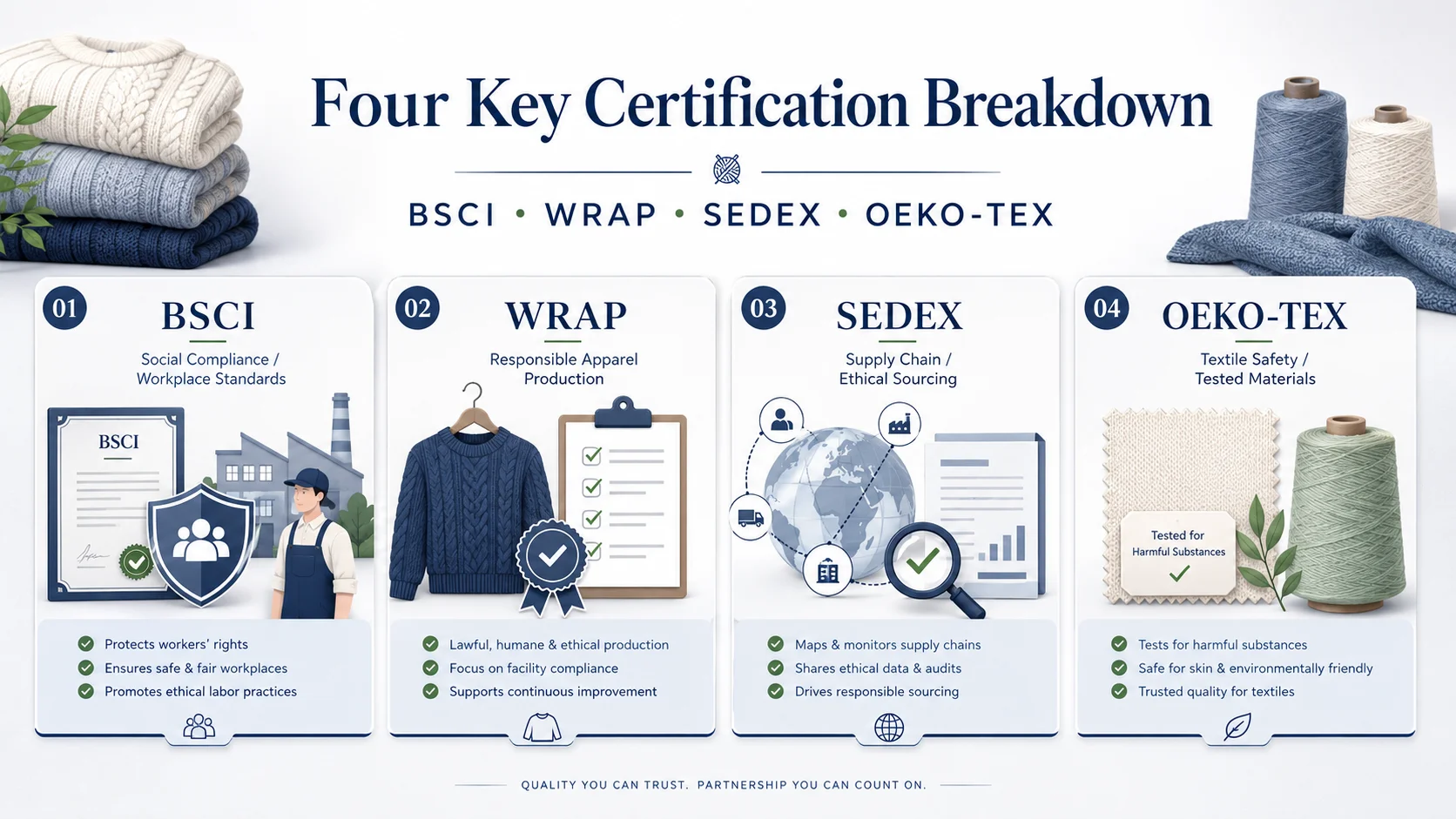
Sweater buyers should not treat BSCI, WRAP, Sedex/SMETA and OEKO-TEX STANDARD 100 as the same type of compliance evidence. amfori BSCI is a social-audit and monitoring system. WRAP certifies production facilities. Sedex is a responsible-sourcing platform that uses the SMETA audit methodology. OEKO-TEX STANDARD 100 certifies textile products or components tested for harmful substances. For buyers, the key is to check what the document covers, whether it is still current, and how to verify it.
The word certification is used loosely in sourcing conversations, and that loose usage causes most of the confusion. In practice it covers four different things: a social-audit programme, a facility certification, a platform with an audit methodology, and a product certification. The easiest way to avoid confusion is to first identify what type of document you are looking at.
Certification, Audit or Product Standard: What Is the Difference?
Each one serves a different purpose, so they should not be treated as interchangeable.
- Social audit and monitoring programme — assesses working conditions and management practices at a production site over time. It produces audit findings and a rating, not a factory certificate. amfori BSCI works this way.
- Facility certification — certifies the production facility itself against a set of responsible-production principles. WRAP works this way.
- Platform plus audit methodology — a membership platform where supplier and audit information is shared, together with a published audit methodology used by approved third-party audit companies. Neither the membership nor the audit is a certification. Sedex with SMETA works this way.
- Product or component certification — certifies the article itself, for example that it has been tested for harmful substances. OEKO-TEX STANDARD 100 works this way.
One type of document cannot replace another. A product certificate, for example, says nothing about how a factory treats its workers.
What BSCI, WRAP, Sedex/SMETA and OEKO-TEX Actually Cover
amfori BSCI
amfori BSCI uses social audits to assess working conditions and management practices at production sites. Auditors gather evidence across 13 performance areas through site observation, worker and management interviews, and document review. The resulting audit report carries a rating, running from A to E, and the most serious findings fall under amfori’s zero-tolerance protocol.
amfori states that BSCI is a social-audit and monitoring framework rather than a standard, qualification or certification system, and that it does not issue certifications. BSCI audits are also not quality, food-safety or product-safety audits — they assess the effectiveness of the site’s social management system. Since 1 September 2024 amfori has accepted only fully unannounced and semi-announced audits.
Buyers should check which production site the BSCI audit covers, its current audit status and the rating shown in amfori. There is no factory certificate to check. An audit shows what was found at that time; it does not guarantee that conditions will stay the same. Buyers may therefore use it together with other supplier checks. Program information is published at amfori.
WRAP
WRAP is a facility certification programme for responsible production. It is built on the WRAP principles, which cover areas such as forced labour, child labour, working hours, wages, health and safety, environmental management and customs compliance. A facility that passes the audit receives WRAP certification.
WRAP changed the structure of its certification on 1 March 2026. WRAP no longer issues certification levels such as Gold or Platinum, and no longer issues two-year Platinum certificates. A facility that passes the WRAP audit now receives a certificate indicating an annual Certification of Compliance. Platinum certificates that were already active remain valid until their stated expiration date. WRAP describes this as alignment with the shift toward annual social audits, which many buyers and regulators now expect.
For a buyer, the useful checks are the facility name and the facility’s current status in WRAP’s records. It is also worth confirming whether the certificate is an annual Certification of Compliance or an older Platinum certificate still inside its original expiry. Guidance and the change notice are published at WRAP, including the update to the WRAP certification programme.
Sedex and SMETA
Sedex is a responsible-sourcing platform used to share supplier and audit information. Membership gives a business access to the platform; it is not a certification and does not by itself indicate a level of performance.
SMETA (Sedex Members Ethical Trade Audit) is the audit methodology created and stewarded by Sedex. It is delivered by third-party audit companies approved by Sedex, and it assesses a site against the ETI Base Code, International Labour Organization conventions and local law. A SMETA audit can be carried out with two pillars — labour standards, and health and safety — or with the full four pillars, which add environment and business ethics.
Sedex describes SMETA as a continuous improvement methodology rather than a certification, and it is not a pass-or-fail test. The audit produces findings and a corrective action plan rather than a certificate. Only Sedex members can commission a SMETA audit and upload it to the platform, so access to a supplier’s report is arranged through Sedex and is often controlled by the supplier.
Because Sedex is a platform rather than a certification, there is no certificate number to search for. What a buyer can check is the site profile on the platform and the date and findings of the SMETA audit that is available to them. Details are published at Sedex, including the SMETA audit methodology and its four pillars.
OEKO-TEX STANDARD 100
OEKO-TEX STANDARD 100 is a certification and label for textiles tested for harmful substances, covering the article from yarn to finished product. Every thread, button and accessory in a labelled article has to meet the applicable STANDARD 100 requirements. The certification applies to the article and its components, not to the factory.
Testing requirements follow the intended use of the textile, and products are placed in one of four product classes. Product Class 1 covers products for babies and children up to 3 years and has the strictest requirements and limit values. Product Class 2 covers products with direct skin contact, Product Class 3 products without direct skin contact, and Product Class 4 home textiles and other decoration materials.
Certificates are issued for one year, and a certificate number or label can be checked through the OEKO-TEX label check to confirm validity and the certified scope. Because STANDARD 100 tests articles for harmful substances, it is not a social-compliance audit and it does not certify a factory’s quality management system. Requirements and the label check are published at OEKO-TEX STANDARD 100.
The table below summarises what each one is, what it covers, and what is worth checking before you rely on it.
| Program / Standard | What It Is | What It Covers | What Buyers Should Verify |
|---|---|---|---|
| amfori BSCI | Social audit and monitoring system | Working conditions and social compliance at a production site | The production site covered, the current audit status and rating, and the audit information available to you |
| WRAP | Facility certification | Responsible production practices at the facility | Facility name, whether the certificate is a current annual Certification of Compliance, and current status in WRAP records |
| Sedex / SMETA | Platform plus audit methodology | Responsible-sourcing and worksite audit information | Site profile, SMETA audit date and findings, and whether access can be provided through Sedex |
| OEKO-TEX STANDARD 100 | Product and component certification | Harmful-substance testing of textiles | Certificate or label number, certified product scope, product class and validity |
How to Verify Compliance Documents Before Ordering
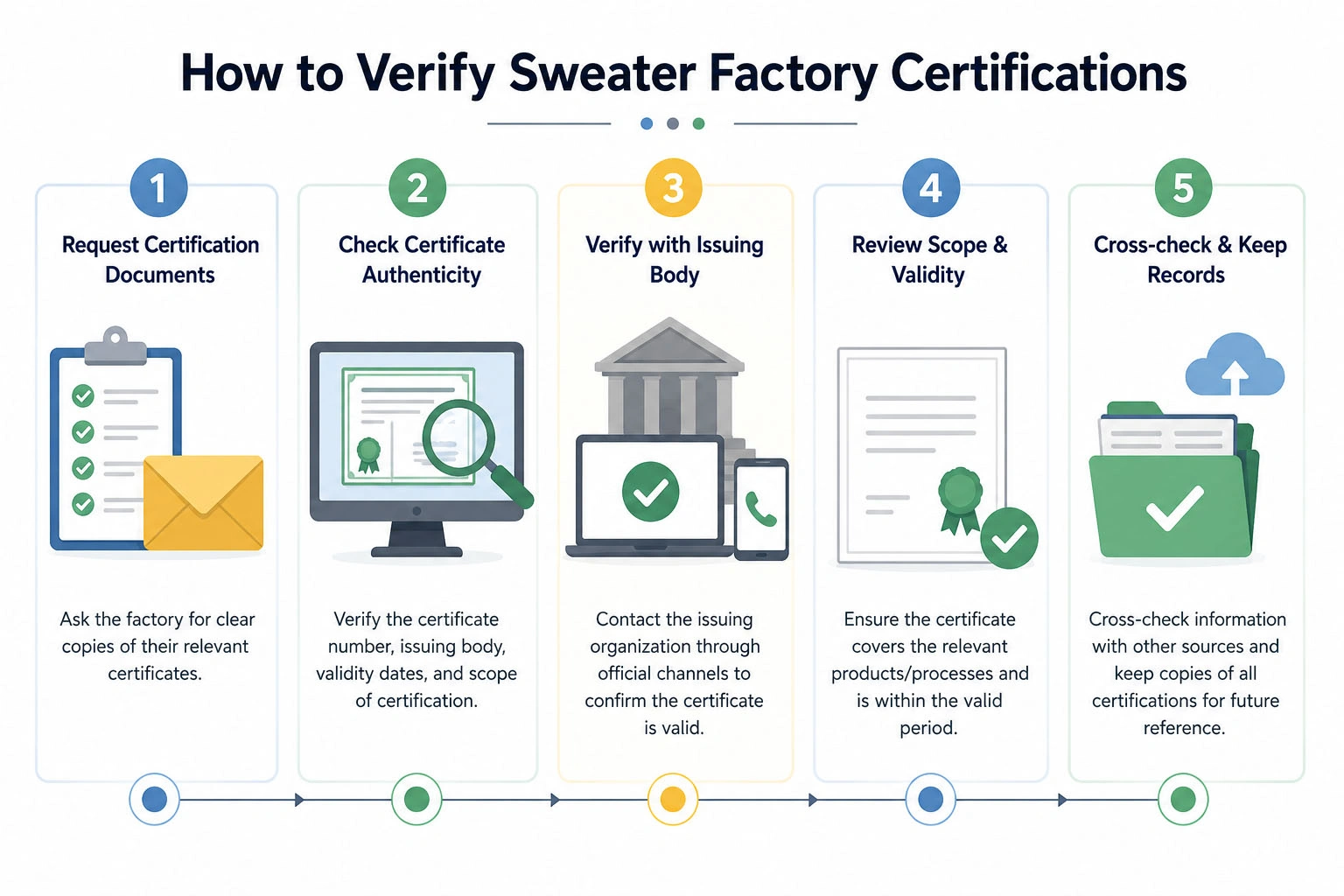
The exact verification method depends on the document. Start by identifying what type of record the supplier has given you.
Step 1: Identify the Type of Document You Are Reviewing
Decide which category the document belongs to: a social audit record, a facility certification, a platform-based audit report, or a product certification. Once you know the document type, you know where to verify it and what information it can actually provide. A SMETA report and a STANDARD 100 certificate are not interchangeable evidence, even when both are current.
Step 2: Match the Legal Entity and Production Site
Compliance records are usually tied to a legal entity and a specific production site. A group may have several factories with different records. Check the entity name, the site address, and the scope the record covers against the site that will actually make your order.
Company names do not always line up neatly. Trading names, translated names and group structures can all differ from the name on the record without anything being wrong. Any difference should be explained and matched to the legal entity and the actual production site. It is not proof of a problem on its own.
Step 3: Check Current Status Through the Official System
Each category has its own verification route, so do not use the same checking method for all four.
- amfori BSCI — use the amfori audit and monitoring records available to you, which are normally accessed through the buyer’s amfori relationship for that production site.
- WRAP — verify the facility’s current certification status through WRAP’s own records and confirm what the certificate in front of you actually is.
- Sedex / SMETA — review the site profile and the available SMETA audit report through Sedex. Because Sedex is a platform rather than a certification, there is no certificate number to search for.
- OEKO-TEX STANDARD 100 — use the official label or certificate check and confirm the certified product scope and product class.
Step 4: Review the Scope, Audit Date and Findings
A logo, a PDF cover page or a supplier’s marketing slide is not verification. Read the record itself: what was assessed, when, which site and which scope it covered, what the findings were, and whether any corrective actions remain open. A facility certification and a social audit report do not contain the same information, and findings are normal rather than a sign of failure.
Step 5: Confirm It Meets Your Buyer Requirements
Different buyers, markets and retailers ask for different compliance evidence, and a record that satisfies one programme may not satisfy another. Confirm what your own buyer or retail customer requires, and confirm it before the order is placed rather than after. If a specific programme or a specific document is required, say so at the enquiry stage.
Common Red Flags to Check
Most problems buyers run into are not elaborate forgeries. They are documents that are real but no longer relevant to the order in front of them.
- Expired or superseded documentation. A record that has lapsed, or a description of a programme that no longer matches how it works, is worth raising with the supplier.
- Wrong production site. The record covers a different site or entity from the one that will produce your order.
- Unexplained legal-entity mismatch. A name or address difference that nobody can account for, rather than one that is simply a trading name.
- Records that cannot be verified. If a claimed certificate or record cannot be verified through the appropriate official system, ask the supplier to clarify before relying on it.
- Only a summary document available. Ask what additional report details or platform access can be provided. Some audit information is access-controlled.
- Missing audit details. No date, no scope, no site reference, or findings that are described but never shown.
- Claims about what a record proves. A social-compliance record does not confirm product quality, and a product certificate does not confirm working conditions.
None of these items is proof on its own. Ask what evidence can be shared and how you can verify it; some audit reports and platform records have access restrictions.
Compliance Documents Do Not Replace Product Quality Control
Social-compliance documents help buyers review labour and responsible-sourcing requirements, but they do not tell you whether the sweaters themselves are made correctly.
Product quality is managed through specifications, measurement charts, sample approval, in-line and final inspection, and where relevant laboratory testing. A current social audit or platform membership does not confirm gauge, measurements, stitch structure, colour consistency or defect rates for a specific production order. A quality control and inspection programme is what covers that side of the order.
Compliance documents help you assess the supplier, while inspections check whether the actual order matches the approved requirements.
Frequently Asked Questions
Do all sweater factories need BSCI certification?
No single social-compliance programme is mandatory for every buyer. Requirements depend on the brand, retailer, market and sourcing policy. Some buyers may request amfori BSCI or another accepted social-compliance framework, while others will accept a different form of evidence. It is worth confirming what your own buyer requires rather than assuming a single programme is universally expected.
Can a supplier participate in more than one compliance programme?
Yes. A supplier may have different audits, facility certifications, memberships or product certifications for different purposes. These should not be treated as interchangeable. A product certification and a social audit answer different questions, and holding one does not imply the other.
Is Sedex the same as SMETA?
No. Sedex is a responsible-sourcing platform used to share supplier and audit information. SMETA is the audit methodology created and stewarded by Sedex and used by approved third-party audit companies. Neither Sedex membership nor a SMETA audit is a certification.
Does OEKO-TEX STANDARD 100 confirm good working conditions?
No. OEKO-TEX STANDARD 100 certifies textile products and components tested for harmful substances. It is a product certification, not a social-compliance audit, and it does not certify a factory’s quality management system.
How often should I re-verify compliance documents?
Check current status before placing a major order and whenever a certificate, audit report or buyer requirement changes. Different programmes use different update and validity rules, so one review interval does not fit all of them. If a requirement is critical to your programme, confirm the current position before the order rather than at shipment.
What if a supplier cannot share full audit details?
Ask what evidence can be shared and whether access can be provided through the relevant platform. Some audit reports are access-controlled and cannot simply be forwarded. If the supplier cannot provide reasonable proof of a claim, do not rely on that claim when approving the supplier for the order.
Conclusion
BSCI, WRAP, Sedex/SMETA and OEKO-TEX STANDARD 100 cover different parts of supplier compliance, so buyers should first identify what type of document they are reviewing. Check that it applies to the correct factory or product, verify its current status, and confirm that it meets your own sourcing requirements.
Compliance documents are only one part of supplier evaluation. Sample approval, quality control and product testing still need to be handled separately.
If your sourcing programme has specific social-compliance or product-testing requirements, share them before development so the required documentation can be confirmed for the project.