
Custom sweater MOQ is not one fixed number. It depends on how many styles you order, how many colors you split the quantity into, and how much yarn each of those colors needs. At our factory the minimum starts at 100 pieces per style, and colors and sizes can be mixed within that quantity. For buyers planning an order, the practical question is not only the number itself, but how to distribute it across styles, colors and sizes.
What Does a Custom Sweater MOQ Apply To: Style, Color, or Order?
Before planning quantities, find out which unit the minimum is attached to. A factory can quote a minimum per style, per color, or per order total, and each one leads to a different order structure.
| Basis | What it covers | What it means for your planning |
|---|---|---|
| Per style | One style specification with its associated programming, setup and approval requirements | A second style may carry its own minimum, depending on how the factory applies its MOQ policy |
| Per color | One color requirement within a style | Spreading a small total across many colors leaves shallow quantities per color, which can be impractical to source and knit |
| Per order total | A combined quantity across several styles or colors | May allow more flexibility where the factory permits order-level consolidation. Shared yarn, gauge or production timing can make consolidation easier, but separate style minimums may still apply. |
Ask which basis a quote is built on. Two quotes that look similar can behave very differently once you add a fourth color or a second style, and a minimum that is quoted per order total does not automatically survive a change in yarn. If you need the background on why minimums exist and which production factors shape them, our sweater MOQ guide covers that separately.
How Color Count Changes the Quantity You Need
Each color draws on its own yarn, which shapes how much has to be sourced, how many approvals are needed, and how the knitting schedule is arranged. A wide color range can also complicate repeat orders because shallow per-color quantities may not align with future yarn availability or dye-lot matching.
The examples below are planning illustrations, not factory policy. Actual per-color minimums depend on the yarn, its availability and how the factory schedules production.
Example Order Structures by Color Count
| Example structure | Total pieces | What the factory sees | Planning implication |
|---|---|---|---|
| 1 style, 1 color | 150 | One color requirement and one main style setup | Generally a simpler structure to schedule and approve |
| 1 style, 3 colors | 150 (50 per color) | Three color requirements, with separate yarn sourcing or color approval as required | Broader shelf appeal, but per-color quantity may be too shallow for some yarns |
| 2 styles, 2 colors | 300 (75 each) | Two style setups, four style/color combinations | More style/color combinations and more development and approval steps |
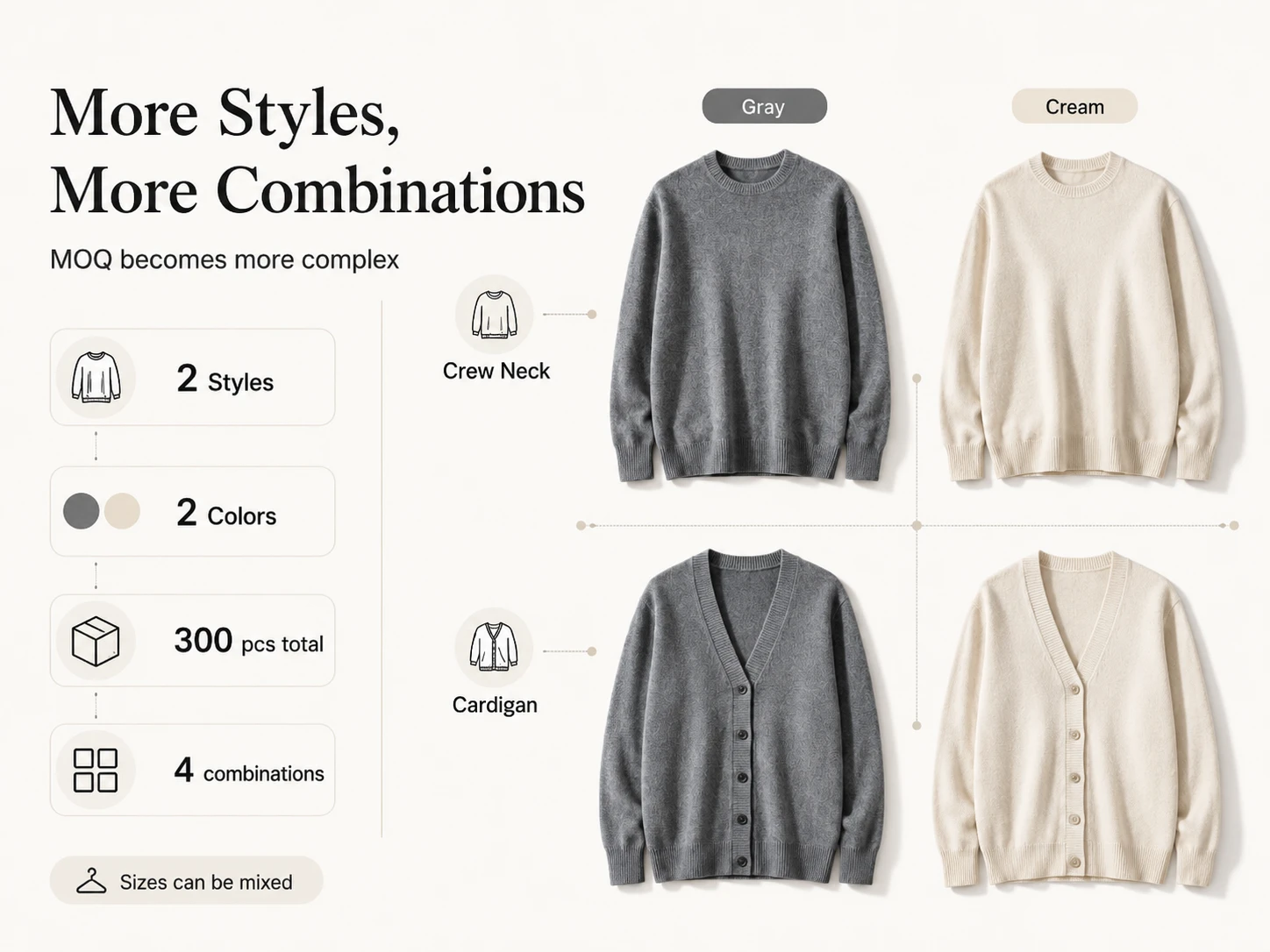 None of these is wrong. The right structure depends on what you can sell and on whether you plan to repeat the style. For some test orders, concentrating quantity in fewer styles may simplify yarn sourcing and production setup. Whether this is preferable depends on the buyer’s merchandising plan and the yarn requirements.
What to Confirm Before Finalizing the Color Split:
- Is this yarn held in stock, or does it have to be dyed or spun to order?
- What is the smallest quantity per color the factory will run for this yarn?
- Can leftover yarn from this order be reserved for a repeat, and for how long?
- What approval reference is required for each color, and where applicable, will a shade band be used to define acceptable variation within that approved color?
Color approvals are a common source of delay in multi-color orders, so it helps to settle the approval route at the same time as the quantity split. Our guide to knitwear color approval and shade control covers how dips, swatches and shade bands work.
How to Split Quantity Across Sizes
Size split affects how inventory is distributed across the expected demand for each size, not just the total quantity ordered. An equal size split does not necessarily reflect actual demand. If historical sales data is available, use it to build the size ratio. For a first order without sales history, define the target market, intended fit and size range, then use a provisional ratio that can be adjusted after sell-through data becomes available.
Knitwear adds one consideration: sizing interacts with stitch structure, shrinkage and the intended fit, so a ratio that works for a woven program may not translate directly. The manufacturer can review whether the proposed size range, grading and production split are practical, but the commercial size ratio should ultimately reflect the buyer’s market and sales plan.
Work through this list before sending quantities:
- Size range and the ratio planned for each size, or the market the ratio should follow
- Whether measurements come from your own spec or from the factory’s base block
- Tolerance expectations on the measurements that matter most, such as chest, body length and sleeve length
- Whether you want a size set for fit confirmation before bulk starts
- Which sizes you expect to reorder first, so yarn and production time can be allowed for
Grading rules and regional size expectations are covered in more detail in our article on sweater size grading for B2B production.
What Raises or Lowers the Minimum for a Given Style
A custom sweater MOQ reflects setup work and material requirements, not a fixed rule. How much each factor below weighs depends on the specification and on how the factory is scheduled at the time.
Yarn availability
A yarn already held in usable stock can reduce the sourcing work required before production. A color that has to be dyed, or a blend that has to be spun, adds a material requirement that has to be met before knitting starts. Fiber choice is covered in our sweater yarn materials guide.
Gauge and machine type
Different gauges run on different machines, and a style that does not match the gauge a factory is running at the time may need a production slot to be found for it. Gauge works together with yarn count, stitch density, stitch structure and garment dimensions to influence yarn consumption and the resulting fabric. See how sweater gauge affects appearance, weight and cost.
Stitch structure and pattern
Jacquard, intarsia and cable work add programming and, in some cases, hand finishing. Whether that changes the minimum depends on the complexity of the artwork and on how many pieces the pattern has to be set up for. Our comparison of jacquard and intarsia knitwear explains what drives the difference.
Trims, labels and packing
Each added component has its own sourcing requirement. Branded labels, special zippers or printed polybags can carry minimums that are independent of the garment quantity, so ask which components are involved and what their own minimums are.
Sample rounds before approval
At lower order quantities, development and setup work is spread across fewer production pieces, which can make the project less efficient to run. A clearer specification before sampling can reduce avoidable revisions caused by changes in yarn, measurements, trims or construction requirements. The stages are described in our custom sweater sampling process guide.
 Five Steps to Plan an Order That Clears the Minimum
 Five Steps to Plan an Order That Clears the Minimum
- Fix the style count first. For MOQ planning, treat each style as a separate production setup unless the factory confirms that specific styles can be consolidated.
- Decide the color count, then check it against the yarn. Confirm the smallest workable quantity per color before committing to the split.
- Build the size ratio from data or a defined market. Avoid equal splits unless your sales support them.
- Lock the specification. Yarn, gauge, stitch, trims and packing should be defined before you ask for a confirmed number.
- Get the minimum in writing, tied to that specification. A change in yarn or color count can change the minimum, so the number is only meaningful next to the spec it was quoted for.
What to Send When You Ask for a Confirmed MOQ
A minimum quoted from only a photograph and a quantity is generally an initial indication. A minimum quoted against a defined specification provides a firmer basis for order planning:
- Number of styles and target quantity per style
- Color count, with quantity per color
- Size range and ratio, or the target market and age group
- Yarn or fiber preference, or a reference sample
- Gauge or weight target, or a reference image
- Artwork and placement for any pattern or logo
- Trims, labels and packing requirements
- Target delivery window
- Whether this is a test order with a planned reorder
If you are still working out the specification, the custom sweater tech pack guide shows what to put in it, and our quote information checklist covers the same ground from the costing side.
Frequently Asked Questions
What is a realistic MOQ for a first custom sweater order?
It depends on the style, the yarn and the number of colors. Our minimum starts at 100 pieces per style, with colors and sizes mixed within that quantity.
Can colors and sizes be mixed within one MOQ?
Yes. At our factory colors and sizes can be mixed within the minimum quantity. One practical constraint is how the quantity is distributed across colors, because each color has its own yarn availability and sourcing requirements.
Does a custom sweater MOQ apply per style or per color?
It depends on the factory and the quote basis. MOQ may apply per style, per color, or in some cases to a combined order total. Confirm the basis again if you add a color, add a style or change the yarn.
Can different styles count toward one total quantity?
At HDL Fashion, our stated minimum starts at 100 pieces per style. Some manufacturers may calculate minimums across a combined order, but this depends on their production policy and the specific styles involved. Shared yarn or gauge may simplify production, but it does not automatically mean different styles can share one MOQ.
Why is the unit price higher at lower quantities?
Setup work such as knitting programming, machine setup, sample approval and yarn sourcing is spread across fewer pieces. Whether a factory can improve the price at a given quantity depends on the specification and on its production schedule.
Will using a stock yarn lower the minimum?
It can, because the material is already available in a usable quantity. The trade-off is that you work within the colors the factory or mill holds rather than a color developed for your collection.
Planning a Custom Sweater Order? Start With the Quantity Split
A workable custom sweater MOQ often depends on how the order is structured across styles, colors and sizes. Defining those variables before requesting a quote makes it easier for the factory to confirm whether the proposed quantity structure is workable. That is the part of sweater order planning a buyer controls directly.
Send us the number of styles, your target quantity per style, the color and size split, your yarn or fiber preference, artwork or logo placement, and your target delivery date. We will confirm whether the order can run at our 100-piece minimum, flag anything in the specification that would change it, and send back a production proposal and quotation. Contact our knitwear team to start.